


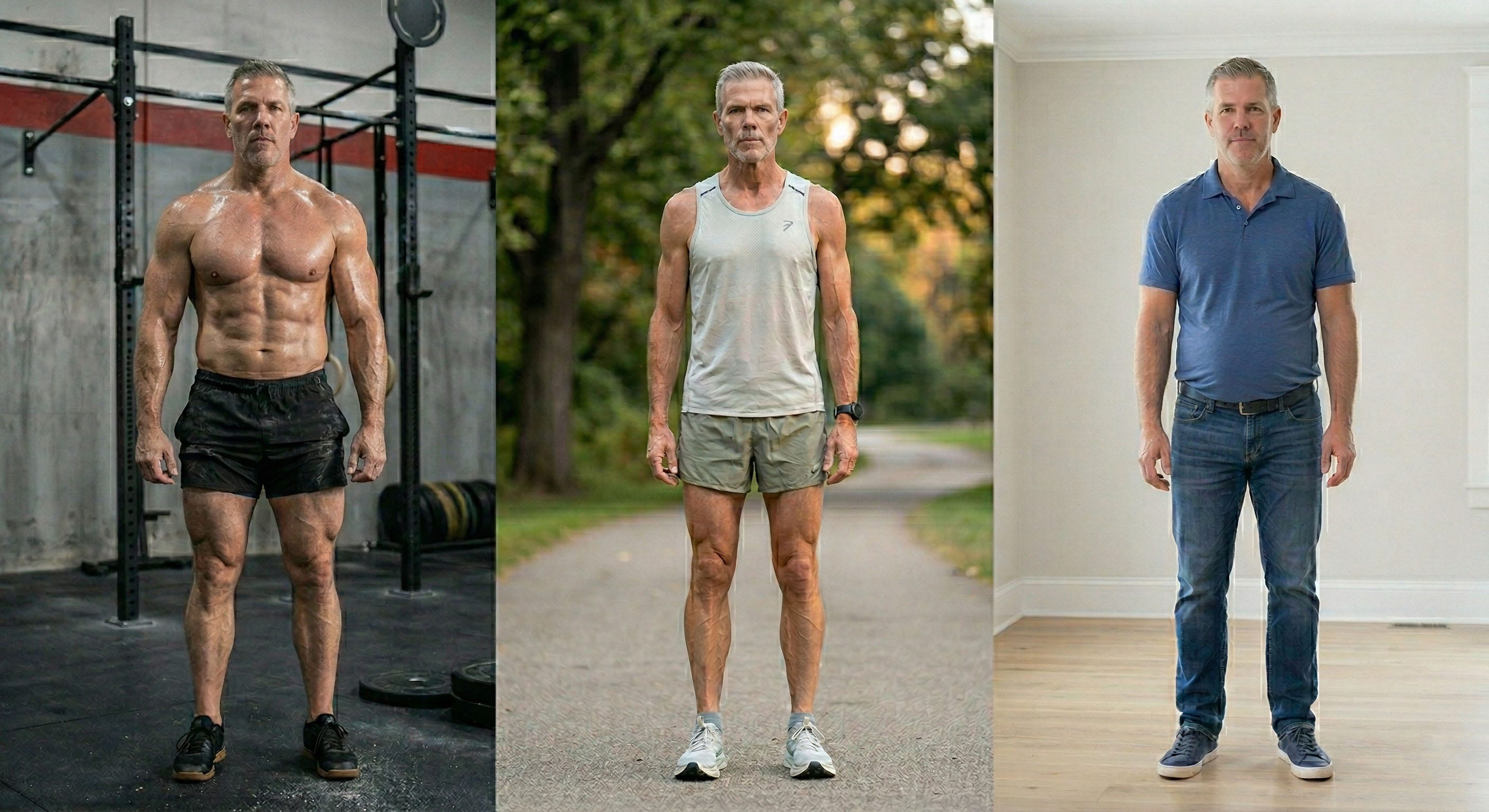
I wear an Oura ring. It tracks my sleep, my heart rate, my steps, my workouts. It knows when I lift. It knows when I do housework. It knows when I ride my motorcycle for two hours on a Saturday afternoon.
Last Friday I did 15 exercises in 43 minutes: seated leg press, Romanian deadlifts, pull-ups, incline press, rows, overhead press, cable crossovers, leg extensions, leg curls, face pulls, Pallof press, triceps pushdowns, curls, calf raises. One working set each, slow controlled reps to failure on every movement. I walked out of the gym spent.
The ring said I burned 2,680 calories that day.
The day before, I cleaned the house, moved some boxes in the garage, did some reorganizing in the kitchen, ran a few errands, and sat at my desk the rest of the afternoon. The ring said I burned 2,570 calories.
A difference of 110 calories. That’s a handful of almonds.
Two completely different days, and the ring treated them as basically the same.
The Flatline
I’ve worn this ring for almost three years. 1,086 days of daily calorie data. Here’s what that data actually shows.
On days I did strength training, the ring logged an average of 2,682 total calories burned. On days the only activity was housework, it logged 2,570. Walking-only days came in at 2,567. Rest days, where I barely moved, still hit 2,460.
From the hardest training day of the week to a day of doing nothing, the entire spread is 222 calories. That’s the contribution your workout makes to the number on your phone. Your resting metabolism and general movement throughout the day account for everything else.
The ring records every one of these activities. It knows the difference between a barbell and a broom. It just doesn’t care when it adds up the day. A calorie burned under a squat rack and a calorie burned pushing a vacuum both land in the same column.
And that’s where it lies to you. Not by withholding data, but by flattening it. By treating all effort as equal output.
It isn’t.
That said, knowing your actual daily burn is worth more than most men realize. Without a tracking ring or watch, you’re relying on whatever number your food app assigned you based on your age, weight, and a dropdown menu that asked if you’re “lightly active” or “moderately active.” That’s a guess. A 300-calorie guess in the wrong direction adds up to 30 pounds in three years. The ring gives you the real number. That matters. The problem isn’t the data. The problem is thinking the data tells you the whole story.
Three Men, Same Scale
Take three men. All 180 pounds. One lifts three days a week. One runs three days a week. The third doesn’t exercise, but he’s active around the house every day. On his feet, busy, always moving.
They all burn roughly 2,600 calories a day. They all eat 2,600 calories. Same protein, same scale weight.
Their bodies look nothing alike.
The lifter carries about 153 pounds of lean mass. Visible muscle in his arms, shoulders, chest, and legs. His body is partitioning protein toward muscle repair and growth because resistance training creates that demand.
The runner carries about 145 pounds of lean mass. More developed legs relative to his upper body, but narrower shoulders, a flatter chest, smaller arms. His calorie burn is real, but the adaptation signal is cardiovascular, not structural. Over time, distance running can actually be mildly catabolic (muscle loss) for upper body tissue.
The active guy carries about 137 pounds of lean mass. Softest appearance of the three despite eating and burning the same number of calories. His activity burns plenty throughout the day, but with no concentrated mechanical tension on muscle tissue and no signal telling his body to build or maintain anything beyond basic function.
Right now they all weigh 180 pounds and burn 2,600 calories. In a year the lifter will still be around 180 but visibly harder. The runner and especially the active guy will have crept up a few pounds of fat unless they cut their food or change their training.
Three identical numbers on the ring. Three different men in the mirror.
The Metabolic Rent
Here’s the part that compounds.
Lean mass is the primary driver of your basal metabolic rate. More muscle tissue means more metabolic activity at rest. Using the Katch-McArdle formula:
The lifter’s BMR is roughly 1,870 calories per day. The runner’s is 1,790. The active-but-untrained guy’s is 1,710.
That 160-calorie daily gap between the lifter and the non-trainer sounds small on a Tuesday. Over a year, it’s 58,000 calories. The equivalent of about 16.5 pounds of fat. The lifter’s muscle is charging metabolic rent every hour of the day, including the hours he’s asleep. The non-trainer’s body doesn’t owe that rent because it doesn’t carry that tissue.
And it gets worse over time. Without resistance training, men lose 3-5% of their muscle mass per decade after age 30. That means the non-trainer’s BMR is quietly dropping year after year. By 50, his maintenance number might be closer to 2,350 or 2,400 while he’s still eating like a 2,600-calorie guy. Slow, invisible weight gain that adds up to twenty-plus pounds per decade. That’s the “I didn’t change anything but I got fat” story that every man past 40 has either lived or watched a friend live.
The lifter is fighting the same clock. Sarcopenia doesn’t care about your gym membership. But resistance training slows it dramatically. His BMR stays relatively stable, or even climbs if he’s still adding muscle. Same birthday, same doctor’s office visits, but with a completely different trajectory.
What I Got Wrong for Eighteen Months
I spent the better part of 2024 undereating. My ring showed a daily burn north of 2,500 calories, and I was eating 1,700 on a good day. Seventy-five percent of my days were in a deficit, averaging negative 617 calories. I thought I was being disciplined.
I was cannibalizing the muscle I already had.
I was already training hard enough. What changed everything was feeding the process. Over the last eighteen months, I brought my protein from 110 grams a day to 150 (higher than that lately while doing my high intensity training program) while keeping total calories close to what I was actually burning. The deficit shrank from nearly 800 calories per day to roughly even. Lean mass went up. Body fat held at 11%. I hit all-time strength records at 64 on a protocol that takes 43 minutes, three days a week.

The ring showed roughly the same daily burn throughout all of it. The number barely moved. What moved was what I put into my body and what my training told it to do with it.
The Number That Matters
Your ring knows what you did today. Your food app knows what you ate. Neither one tells you the thing that actually determines your outcome: whether the demand you placed on your body built the tissue that raises your metabolic floor, or just burned calories that could have come from anywhere.
The man who lifts three days a week and eats enough protein to rebuild isn’t just training differently. He’s becoming a different machine. One that burns more at rest, holds more muscle under the skin, and compounds that advantage every year instead of losing ground.
You don’t pull your calorie number out of a hat. Your body earns it. The type of work you do determines what that number is.
The ring can’t tell you that. The mirror can.
The eighteen months I spent undereating in 2024 cost me muscle I had to rebuild. The Last 10 Pounds is the twenty-year version of finally getting this right: 34,000 logged meals, training data through eleven adult surgeries, and the principles that separate guys who keep their muscle into their sixties from guys who quietly lose it without noticing. The ring number alone is wasted years if you don't know what to do with it.
The Kindle edition is $9.99. The first chapter’s free on my website:

Vic built and sold ScreenRant.com and GameRant.com, then rebuilt himself in his sixties.
He writes at TheRedeemedSecondHalf.com for men rebuilding the second half of life.
What You’re Not Tracking is Keeping You Soft

Guy after guy, the answer is usually the same when nutrition comes up: “I think I eat pretty well.”
You Don’t Need More Sets

If you’re over 40 and you’ve either stopped lifting because you can’t train the way you used to, or you’re still grinding through 90-minute sessions and wondering why your joints ache and your strength is going backward, there’s a protocol you should know about.
Loved it bro 🤜🤛
I’ve been training around 18m after a break. Some small results but haven’t eaten enough protein. My watch says I burn 1930 calories when resting and 2300 calories/day on average over last year. Like you I struggle to eat 1700 cals/day. Started keto yesterday = 1250 calories eaten including 150g of protein. I think you are saying I need to eat 2300/day but if keto then not via carbs but more fat ?