
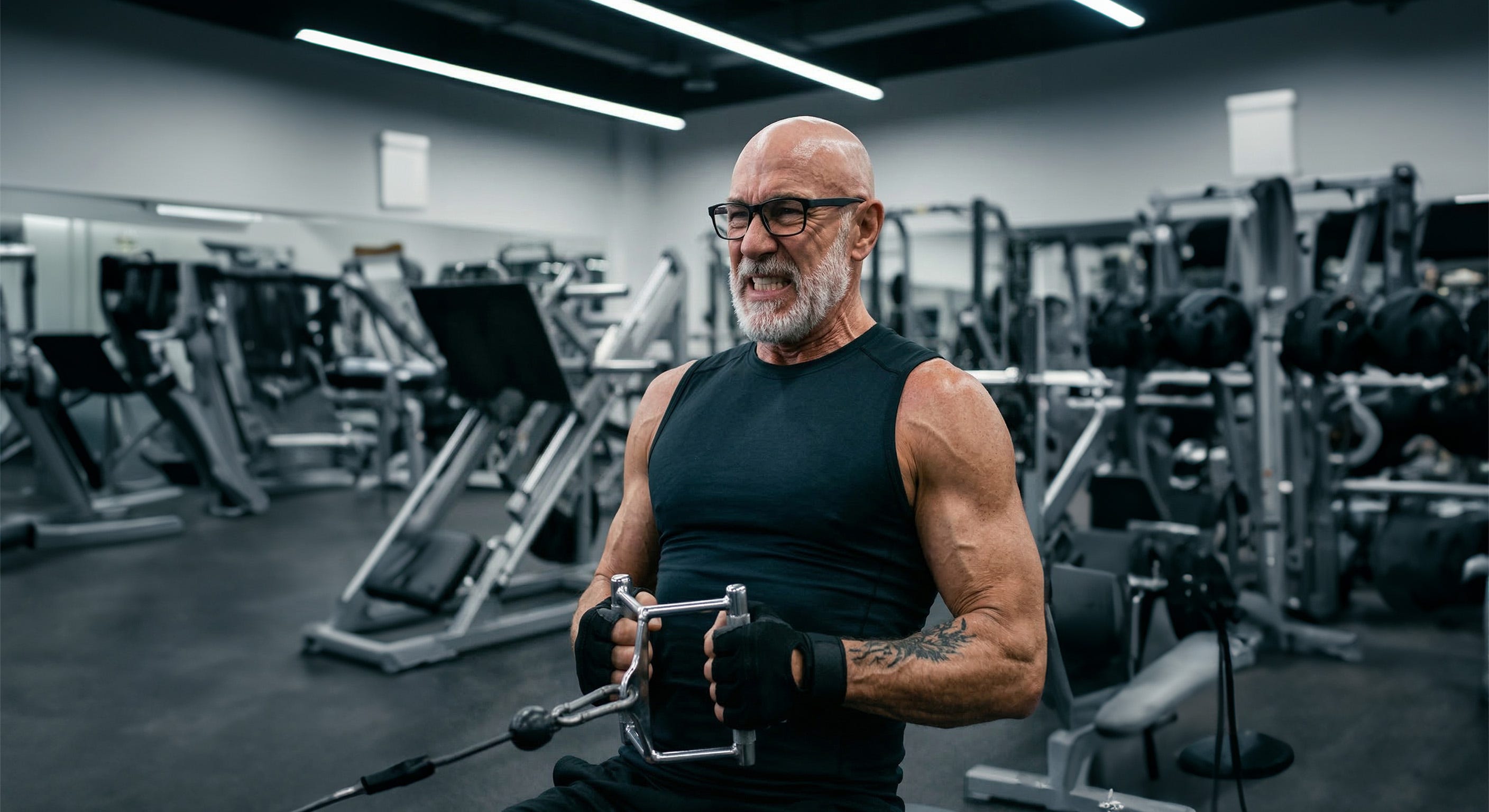
You Don’t Need More Sets
How I hit all-time strength records at 64 while training less than ever.
If you’re over 40 and you’ve either stopped lifting because you can’t train the way you used to, or you’re still grinding through 90-minute sessions and wondering why your joints ache and your strength is going backward, there’s a protocol you should know about.
It takes less than 45 minutes. You do it three days a week. One working set per exercise, full body, every session. And it may be the single most effective way for an older man to build real strength without destroying himself in the process.
Where It Came From
It’s called High Intensity Training, and it goes back to 1973.
Arthur Jones, the inventor of Nautilus machines, ran what became known as the Colorado Experiment at Colorado State University. The premise was simple and controversial: brief, brutally intense workouts taken to muscular failure would produce better results than the long, high-volume sessions every gym in America was built around. The results were disputed, but the core principle has held up for over fifty years and it sparked my curiosity.
The concept is that you don’t need more sets, you need harder sets.
How It Works
Twelve to fourteen exercises covering the full body (I did 15). One working set each. Every rep is a slow, controlled 6-count on the way up and a 4-count on the way down except for a couple exercises that focus on negative reps.
No momentum, no bouncing, no jerking the weight. You go until you can’t complete another rep in good form. That’s it. You’re done with that exercise. Move to the next one.
That tempo is the key, and it’s why this works so well for older bodies.
A single set of 10 reps at that speed keeps the muscle under continuous tension for about 70 seconds. A conventional four-set approach at normal tempo delivers roughly the same total tension, but it’s broken into pieces with rest periods in between where the muscle partially recovers. The slow set never lets up. One set delivers the stimulus of four. And because every rep is controlled through the full range of motion in both directions, your joints, tendons, and connective tissue aren’t absorbing the shock of momentum and sudden direction changes. You’re loading the muscle, not the structure around it.
For a guy over 40 with some mileage on his body, that distinction matters more than anything in a program.
What It Did For Me
I’m 64. I have a fused spine, structural scoliosis, 66% lung capacity, and an irreparable rotator cuff from my second shoulder surgery. I’ve been logging workouts for 4.5 years across multiple programs. Four weeks ago I switched to HIT.
In those four weeks, 10 of 15 exercises hit all-time personal records. Not “best since the surgery.” All-time. Seated leg press went from 220 to 335 pounds. Seated row from 85 to 115. Leg extensions from 70 to 90. Bicep curls, calf raises, hip thrusts, all at recorded peaks. A body composition scan showed I gained 1.4 pounds of lean mass while body fat dropped from 10.9% to 10.7%. My arms grew half an inch. Shoulders grew a full inch. Waist didn’t move (it’s 33”).
Before this, I was running a 5-day split. Four sets per exercise, five exercises per session, different muscle group each day. Almost four sessions a week. And over three weeks, my deadlift dropped 20 pounds, my stiff-leg deadlift dropped 20, and my standing calf raises dropped 20. More volume, more time in the gym, and I was going backward on the movements that stress the spine the most.
The exercises still below their all-time peaks tell an honest story too. Incline press is at 37% of where it was in 2022. Cable crossovers at 22%. Every movement that runs through my destroyed shoulder is permanently recalibrated. But every movement that doesn’t go through that shoulder is at or above the best numbers I’ve ever recorded. The protocol didn’t fix structural damage, but it gave my body a way to work around it and still progress.
Why This Fits Older Bodies
Here’s why I think this is the right approach for most men over 40, especially those carrying injuries, joint issues, or the general wear of decades of hard use.
The slow, controlled reps eliminate the two things that hurt older bodies the most: momentum and ego. You can’t cheat a 6-count concentric (or eccentric, on negatives). You can’t swing the weight. You can’t load up the bar past what you can actually control through the full range. Every rep is honest. And because the rule is to stop at the last rep you can complete in good form, not the last rep you can grind out with deteriorating technique, you’re building strength without accumulating the micro-damage that turns into chronic problems over months and years.
The recovery math is better too. Three sessions a week (original protocol was every other day), full body each time, with complete rest days between. No muscle group goes more than two or three days without a stimulus, but you’re never asking a 50-year-old’s recovery system to handle what a 25-year-old’s can. You walk in, you work as hard as you’re capable of working for 44 minutes, and you leave. That’s the whole program.
I’m not a trainer or a doctor. I’m a 64-year-old man with a body that’s been through 11 surgeries and a complete life rebuild, and this is the most effective training protocol I’ve found in over four years of documented work. The data backs it up. The mirror backs it up. And I don’t spend half my week in the gym to get there.
If you’ve been telling yourself you can’t make real progress anymore, that the best you can hope for is maintenance, that your body is too beat up to build anything new, test that assumption. Three days a week. One set per exercise. Slow and controlled. Stop when your form breaks.
You don’t need more time. You need harder minutes.
If you want to test this for yourself, run the protocol exactly as written for four weeks. Three sessions a week. One working set per exercise. Track the numbers.
The Protocol
Fifteen exercises. One working set each. Slow 6-second concentric, 4-second eccentric. Full body, three days per week.
Here’s the actual workout.
The Rules
One working set per exercise except for the first, which is a warm up. Every rep is a slow 6-count on the concentric (lifting) and a 4-count on the eccentric (lowering). No pausing at the top or bottom. Continuous tension, continuous movement. The weight should be heavy enough that you reach failure somewhere between 8 and 12 reps. If you get to 12 with good form, add weight next session. If you can’t hit 8, drop it.
Failure means the last rep you can complete with proper form. Not the last rep you can grind out with your back arching, your hips shifting, or your momentum taking over. When form breaks, the set is over. This is the single most important rule in the program. It’s what makes it sustainable for older bodies and what separates it from ego lifting.
A few exercises use negative-only reps instead of the standard tempo. On those, you lift the weight for a 4-count and then lower it on a slow, controlled 6-count. The lowering phase is where the muscle does the most work. I’ll note which exercises are negative-only in the lists below.
Full body, every session. Three days a week with at least one rest day between sessions. The original Jones protocol was every other day. Either works. Do not train two days in a row.
Warm up however you normally do. I do 5 minutes on the exercise bike. Then start.
The Original Protocol (14 exercises)
This is the unmodified version for someone without significant structural limitations. Jones originally designed the protocol around his Nautilus machines, which used a cam system to vary resistance through the range of motion. Those machines are rare now. Standard gym machines and free weights work fine. The principle is the tempo and the intensity, not the equipment.
Leg Press (Warm up + actual set)
Squat
Romanian Deadlift
Standing Calf Raise
Incline Dumbbell Press
Seated Shoulder Press
Dumbbell Lateral Raise
Pull-Ups
Bent-Over Row (negatives)
Lat Pulldown
Leg Extension (negatives)
Leg Curl (negatives)
Barbell Curl (negatives)
Triceps Extension
My Modified Protocol (15 exercises)
I have a fused L5/S1, structural scoliosis, and an irreparable supraspinatus tear in my right shoulder. These swaps let me train the same muscle groups without loading the structures that can’t handle it.
Seated Leg Press (replaces Squat — removes spinal compression)
Hip Thrust (replaces Romanian Deadlift — loads the posterior chain without stressing the lower back. I started with RDLs and swapped when my back told me to.)
Incline Dumbbell Press (replaces Bench Press — I kept this but at significantly lower weight due to the shoulder. 35 lbs now vs. 95 in 2022. Still progressing within the new ceiling.)
Pull-Ups (kept — 6-count up, 4-count down, full extension at the bottom. These are brutally different from normal-pace pull-ups.)
Seated Row (negatives) (replaces Bent-Over Row — eliminates the spinal load of the hip hinge position)
Seated Overhead Press (replaces standing Shoulder Press — seated removes much of the spinal load)
Straight-Arm Lat Pulldown (replaces traditional Lat Pulldown — standing, arms extended, pulling the bar downward. Isolates the lats without bicep assistance. Different exercise entirely.)
Cable Crossover (negatives) (added — not in the original protocol. I added this because my upper chest is underdeveloped. Also at reduced weight due to the shoulder.)
Leg Extension (negatives)
Lying Leg Curl (negatives)
Face Pull (negatives) (added — rear delt and upper back work that supports shoulder stability. Replaces Lateral Raise, which I can’t do because of the shoulder.)
Pallof Press, 2 sets (added — anti-rotation core work. 2 sets, one set per side. Important for spinal stability with my fusion and scoliosis.)
Triceps Pushdown (replaces Triceps Extension — easier on the shoulder)
Alternating Bicep Curl (negatives)
Seated Calf Raise, single leg (replaces Standing Calf Raise — I do each leg individually to prevent the stronger side from compensating)
Notes
The order matters. Compound movements first, isolation work after. Legs before upper body. You want the big muscle groups working while you’re freshest.
Don’t rush between exercises. You’ll be breathing hard, especially in the first two weeks. Take enough time to set up the next exercise properly, but don’t sit on your phone for five minutes. You’re meant to move from one exercise to the next with minimal rest, about a minute or two. The session should take about 40-45 minutes total.
Track everything. I use the Strong app. Weight, reps, and whether the set felt like true failure or if I had something left. If you’re not tracking, you’re guessing, and guessing doesn’t produce the kind of progression I showed above.
Expect the first two sessions to feel disorienting. The weight will feel light because you’re used to loading for normal tempo. By rep 6 or 7, you’ll understand why the weight is right. By session 3, you’ll understand the program.
If you’re coming from a traditional split and you’re used to leaving the gym with energy to spare, that’s over. This program will empty the tank in under 45 minutes. Plan accordingly.
Vic built and sold ScreenRant.com and GameRant.com, then rebuilt himself in his sixties.
He writes at TheRedeemedSecondHalf.com for men rebuilding the second half of life.


