


Guy after guy, the answer is usually the same when nutrition comes up: “I think I eat pretty well.”
I used to say it too. Then I started writing down everything I ate, and realized I was off by 300 calories a day in snacks I wasn’t counting, drinking more often than I thought, and hitting my protein target about a third of the time.
“Pretty well” is a guess. And you can’t fix your body on a guess.
If you read last week’s piece on training, you know I hit all-time strength records at 64 on a protocol that takes 44 minutes, three days a week. People want the exercises, the sets, the rep scheme. I get it. The workout is the exciting part.
The workout isn’t the reason I’m 160 pounds at 11% body fat.
The reason is boring: I track what I eat.
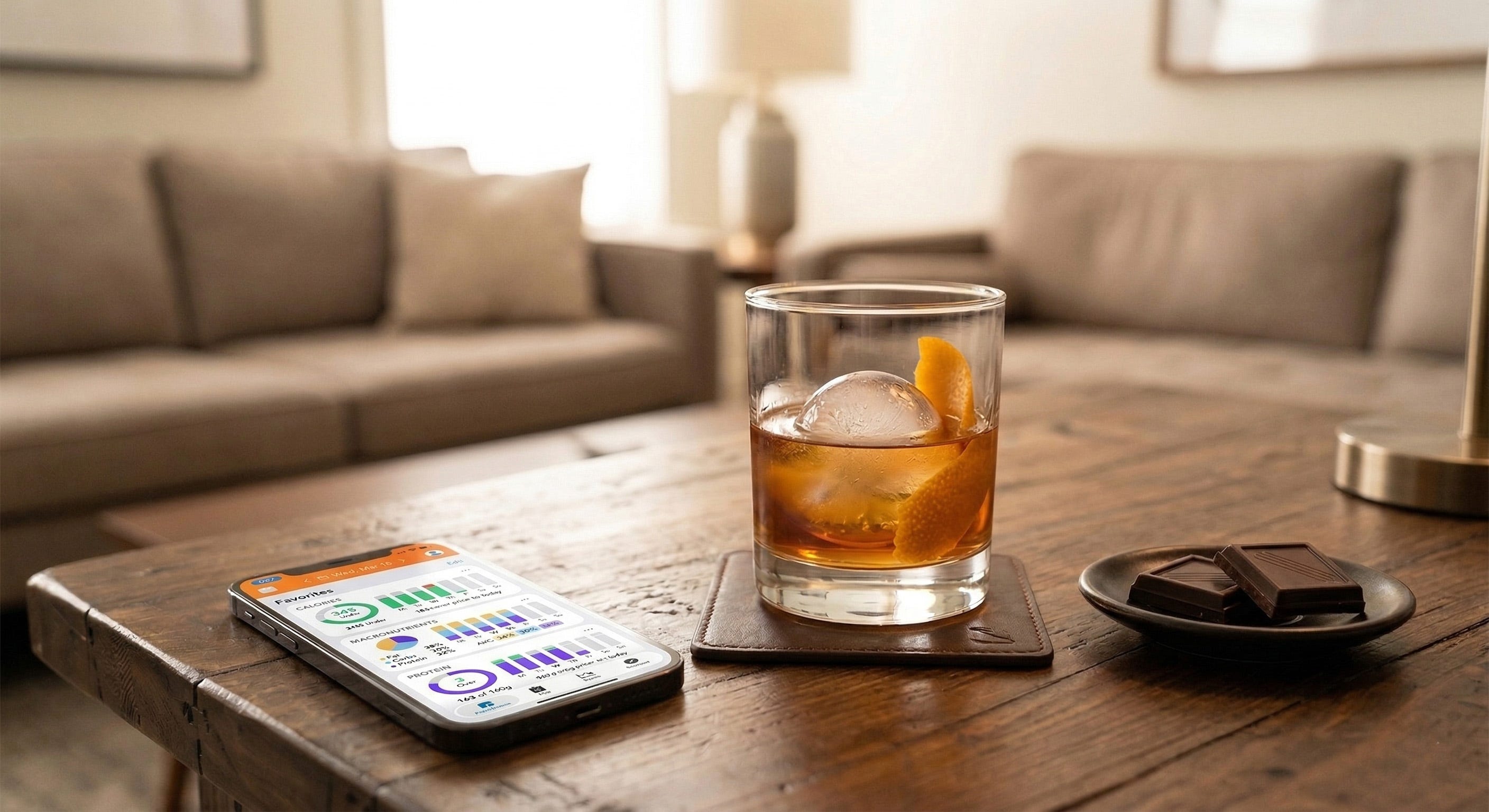
Every day. Every meal. Every Old Fashioned and every handful of dark chocolate. I’ve been doing it since 2010 using the Lose It app. Over 34,000 individual entries across fifteen years. I can pull up what I ate on a random Tuesday in 2014.
That’s it. That’s the whole nutrition secret.
What Tracking Actually Does
Guys think tracking food is about restriction. Count calories, eat less, lose weight. A deficit matters when you’re dropping body fat, but that’s not the main thing the log does.
The log creates awareness. When I see 1,600 calories and 70 grams of protein at the end of a day, I know I under-ate and tomorrow I need to make up the difference. When I see 2,800 calories with 400 of them from bourbon, I know the week needs a course correction. I’m not reacting to the mirror three months later wondering what happened. I’m seeing the data in real time and making small adjustments before they compound.
Here’s what I mean by awareness. In 2023, I logged 16 days the entire year. In 2024, I managed 101. In both of those years I saw the result of that in the mirror with a softer midsection and less muscularity.
Last year I logged 345 out of 365 days. The twenty I missed were travel and holidays. In February of this year, my daily calorie intake varied by only 12% from the average. I wasn’t white-knuckling through some strict meal plan. I was eating the way I eat and documenting it.
The difference between those years isn’t discipline. It’s data. When I’m logging, I course-correct in real time. When I’m not, the damage is invisible until it shows up in the mirror months later. The skill isn’t perfect consistency. It’s restarting.
You can’t manage what you don’t measure. I have fifteen years of data proving it.
The Part That Breaks People’s Brains
Here’s where guys who follow “clean eating” programs lose their minds.
My snack window runs close to a thousand calories a day. Gluten-free pretzels. Dark chocolate Dove Promises. Keto ice cream bars. Old Fashioneds on the weekends.
Keep in mind “snacks” for me aren’t just what I eat sitting on the couch at the end of the day. They’re whatever I eat that doesn’t fall into breakfast, lunch, or dinner: protein shakes after a workout, beef sticks in the afternoon to hold me over until dinner. It’s over a third of my total daily intake, and I’m not embarrassed by that number. I’m reporting it because it’s real.

If you’re over 40 and you’ve tried to get lean and failed, odds are good you were eating clean during the day and blowing it at night with food you never wrote down. I enter it into my app. All of it.
My daily average is about 2,400 calories. I’ve averaged around 150 grams of protein over the last three months, roughly 27% of total calories. Breakfast runs about 350 calories — Greek yogurt with berries, a banana, black coffee, and whey protein — with about 40 grams of protein before I leave the kitchen. Lunch is a protein bar, hard-boiled eggs, maybe some bone broth or leftover soup. Breakfast and lunch combined land around 850 calories. Dinner is where I eat. Chicken breast, stir fry, ground beef, brisket when we’ve made it. Six to seven hundred calories with another 50 grams of protein.
I’ve refined this pattern over the last four or five years and really dialed it in over the past twelve months. I eat light during the day and heavy at night. Nutritionists would tell you to spread your meals out. I tried that. It doesn’t fit how I live, train, or want to eat.
The best nutrition approach is the one you’ll do for years. Not the optimal one on paper.
The Protein Threshold
The one number that matters more than calories is protein. I’ve found over years of data that 140 grams per day is the line where things work for me. Above it, I hold muscle and stay lean. Below it, I soften. Last year I hit that threshold on 61% of my days. The years where I looked my worst, that number was below 20%.
The general formula is 0.8 to 1.0 grams of protein per pound of body weight. If you’ve got weight to lose, use your goal weight instead of your current weight. At 160 pounds, my target range is 128 to 160 grams. I aim for the upper end.
The sources aren’t glamorous. A chocolate protein bar shows up in my log almost every day, sometimes twice. Oikos Pro yogurt. Whey protein. Hard-boiled eggs. Chicken breast cooked in bulk. I’m not eating for Instagram. I’m eating to hit a number and move on with my day.
The One Thing
You don’t need a meal plan. You don’t need to eat clean. You don’t need to go keto or do intermittent fasting or whatever the fitness industry is selling this month. Having targets for things like carbs and sugar helps — I have them, and they keep me honest when I’m tempted to blow past them — but no single restriction is the answer.
You need to track what you eat. Every day. Honestly.
Get the Lose It app or MyFitnessPal or whatever works. Set a calorie target. Set a protein target based on your goal weight. Log everything — including the stuff you don’t want to see in the data. Do it for 30 days without skipping.
You’ll learn more about why your body looks the way it does in those 30 days than in the last five years of reading nutrition articles.
I eat dark chocolate almost every night. I drink Old Fashioneds on weekends. I have ice cream bars in the freezer. And I’m walking around at 11% body fat at 64 years old after a dozen surgeries, a fused spine, and a body that fights me on everything.
Your body is the first thing God gave you to steward. Every entry in that log is a small act of telling the truth about yourself.
The food isn’t magic. The tracking is.
What you saw in this piece is one slice of a fifteen-year experiment that never ended. The Last 10 Pounds is the rest of it: the food logs from 2010 forward, the years I let the tracking slide and watched the consequences show up in the mirror, the data from 13 surgeries that never let me coast. You're at the front end of the same loop I've been running. The book is what 15 years of running it looks like with the receipts attached.
The Kindle edition is on pre-order for $9.99 and ships June 30. If you don't want to wait, the PDF is $9.99 and downloads now. The first chapter's free on my website:

Vic built and sold ScreenRant.com and GameRant.com, then rebuilt himself in his sixties.
He writes at TheRedeemedSecondHalf.com for men rebuilding the second half of life.
You Don’t Need More Sets

If you’re over 40 and you’ve either stopped lifting because you can’t train the way you used to, or you’re still grinding through 90-minute sessions and wondering why your joints ache and your strength is going backward, there’s a protocol you should know about.
The First Thing Every Man in His Second Half Should Fix: His Body

If you feel stuck, start with your body.
Started tracking at the start of this year. Had been working out steadily for almost 20 years, but never tracked food until now. In about 3 months, I'm down almost 10 pounds (from 175 to 165). No strict diet or crazy foods, but I've noticed a couple of things: I've almost completely stopped snacking, and I almost never eat seconds. My portions have gotten smaller and I don't feel hungry very often. It's been a slow change, but definitely one I'll keep doing.
Love this