


I’ve had a screwed up spine for so long that I tend to forget what it looks like. I’ve known I had scoliosis for 40 years. I feel it, but the reality of how bad the curve is fades into the background.
A few months ago I sat down with a woman who has spent decades teaching the Schroth method: exercises, stretches, and breathing that reduce the effects of scoliosis.
Part of the initial appointment was to bring her an X-ray of my spine, which she fed into software that reconstructed it in 3D. I hadn’t looked at an X-ray of my spine in years, and it was quite jarring to see the degree of curvature, and the long screws inserted at the base from a fusion I had 20 years ago.
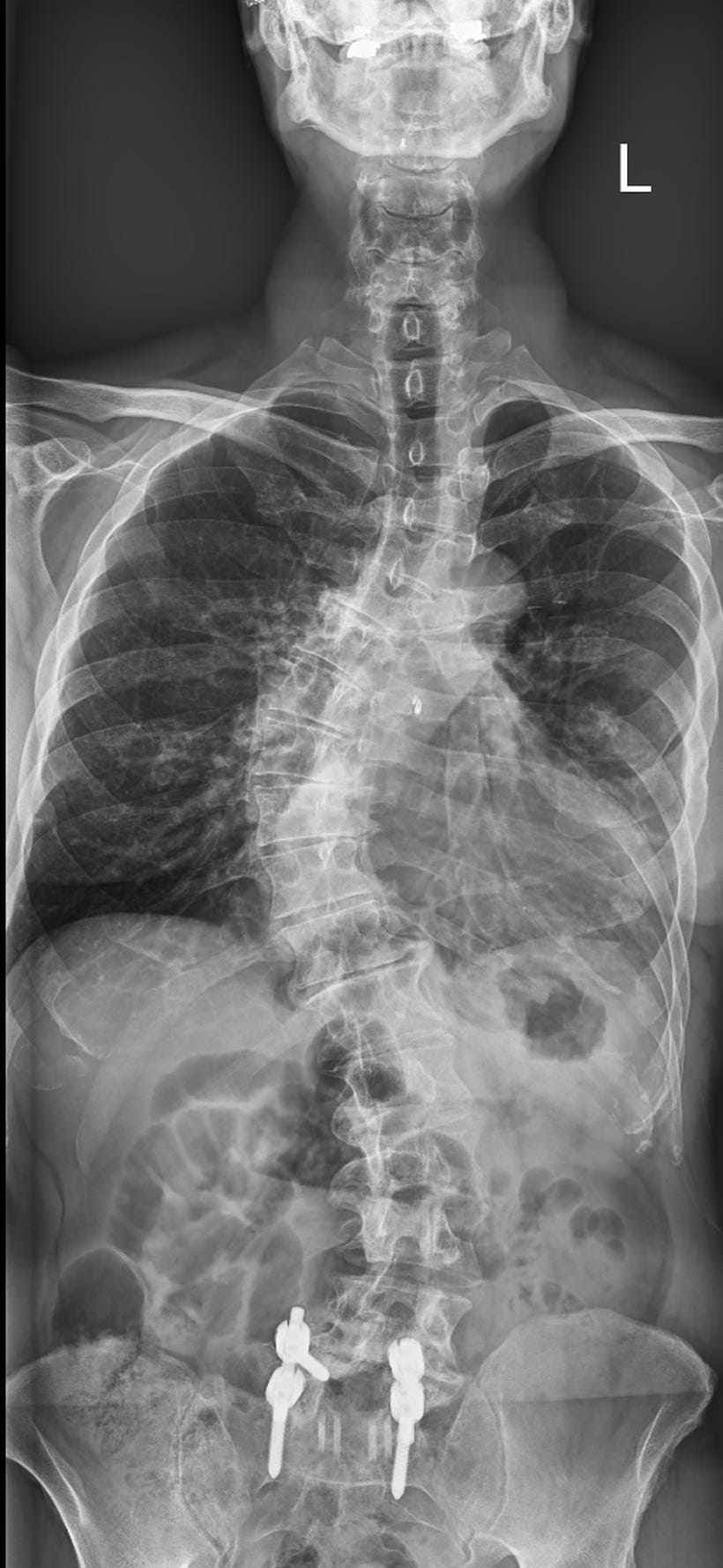
One thing she pointed out that I had never thought about was that I didn’t just have lateral curvature. Scoliosis also rotates the spine in an unnatural way.
It was then that I decided to retire the deadlift.
What the lift was holding up
It was hard to give up the deadlift. Not because of health reasons, but because of what it meant to me as a man. It felt like surrender, one more thing that I couldn’t do as the years piled on. It hurt my ego to think that I could no longer pull heavy. The deadlift told a story. I was still the kind of man who could lift heavy things off the floor.
But as you get older, you’re supposed to get wiser, and just one year prior, trying to “lift heavy, bro,” I had torn my rotator cuff in my right shoulder, and this time the tear was permanent and irreparable. So the reasonable part of me was going to win this argument. For the same reason, barbell squats went the same week, and barbell calf raises as well.
My ego had a strong opinion about all of it. I read every subtraction as surrender. Quitting anything was a loss, regardless of what the benefit might be. It didn’t care about cost or consequences.
The substitution
Here’s what giving up those exercises looks like in practice, because this is where the ego’s argument falls apart. Hip thrusts took over for the heavy pulls. The seated leg press took over for squats, and my numbers on it kept climbing after I switched over.
At 64 I was stronger on several machines than I’d ever been, with a spine that’s fused at the bottom and curved in the middle.
Eventually, the story lost its power. I kept every ounce of the training effect. The criterion, once I quit negotiating, was simple: every movement is replaceable, and the joint isn’t. A lift is a tool for loading muscle, and when a tool starts costing more than the job pays, a mechanic swaps the tool.
I’m not saying the replacements are biomechanically identical – they’re not. But they’re close enough, and they’re a lot better than quitting entirely. The muscle does not know what the movement is called.
There’s a reason beneath this. The body I train isn’t mine to wreck in order to feed my ego:
“You are not your own, for you were bought with a price. Therefore honor God with your bodies”
(1 Corinthians 6:19–20)
Stewarding the body God entrusted to me is the whole point. No single lift is worth more than that.
Every Sunday I write for men who are done pretending the first-half approach still fits. Subscribe if that's you:
Your deadlift
Maybe yours isn’t a deadlift.
It’s the full-court pickup game at 55. The rec-league slide into second. The ladder to your home’s roof with nobody home. The 10K you keep entering because the man you were at 38 ran it. Somewhere in your week there’s a movement or a load that’s serving your memory more than your body.
Take an inventory: what hurts more than it should after you’ve done it? What has your doctor warned you about? Be honest with yourself about it. Try to remove your ego from the equation.
The test I’d hand you is the one my X-ray handed me: ask whether the thing serves the man you are or memorializes the man you were. The barbell doesn’t miss me, and my back hurts a fraction of what it did before.
And notice what subtraction is not costing you. I train as hard as I ever have. I push hard on every working set; I just do it on different equipment now. The men who confuse the movement with the mission end up in rehab instead of training, and rehab is where the second half stalls, one torn tendon and one bad year at a time. I’ve spent enough seasons in slings to know how that works out.
You can subtract a movement and still train. Find a workaround for the one you gave up. It can still be the most advanced set you ever perform, even if nobody applauds. It will buy you years of fitness you’d otherwise spend in recovery.
Retire the lift. Keep the man.
Vic built and sold ScreenRant.com and GameRant.com, then rebuilt himself in his sixties.
He writes at TheRedeemedSecondHalf.com for men rebuilding the second half of life.
Giving up one lift is not giving up on strength. It is choosing to keep training instead of spending the next year in rehab.
Great advice, Vic. I'm in a similar position with some old injuries. Will start looking into some workarounds. Great article.