


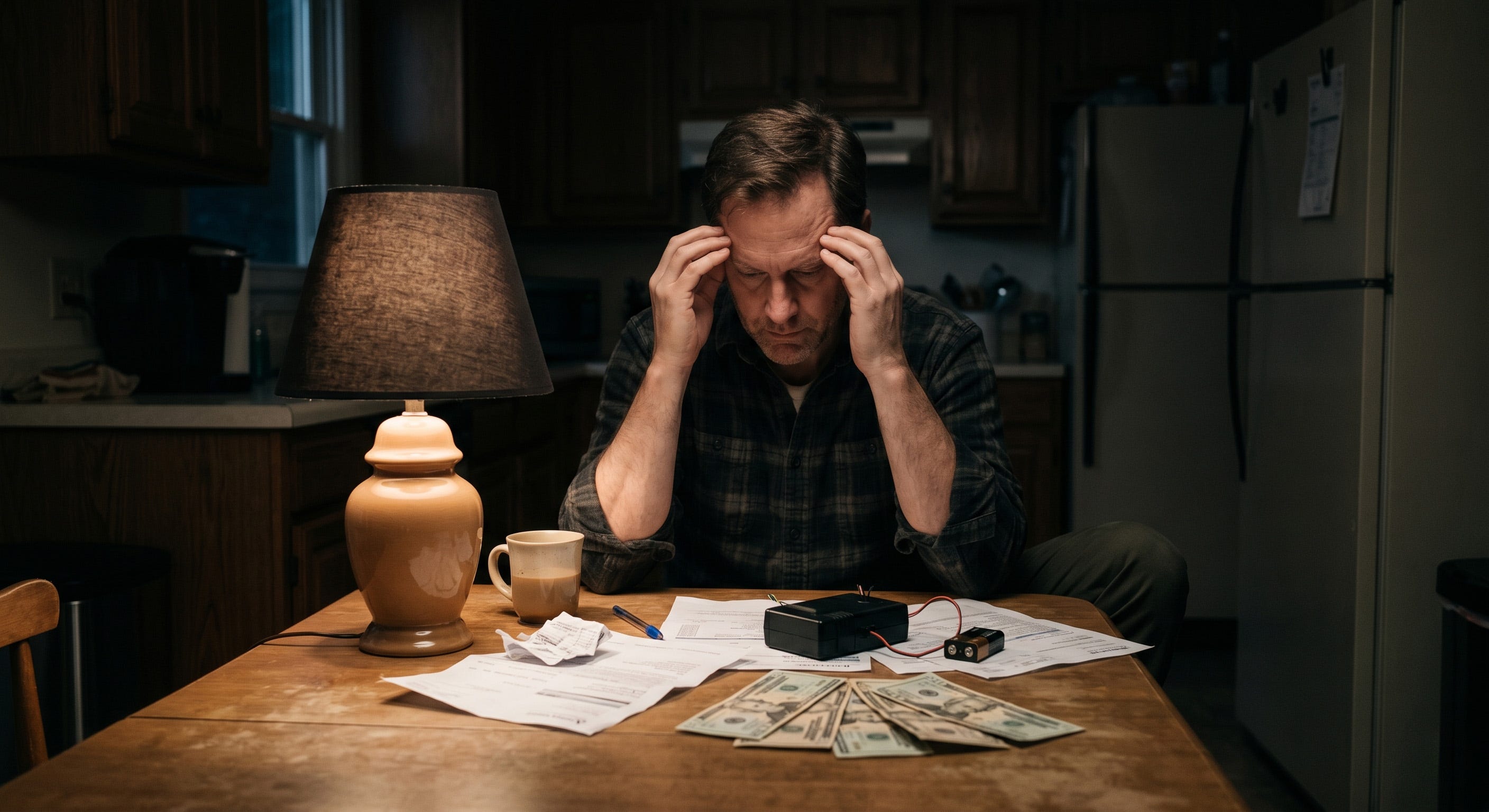
I was in my twenties, a fry cook with no plans for the future, and convinced I could be an amateur card counter. I wasn’t. I couldn’t count past +6 without losing track of the conversation at the table. But I’d read a book about it and that was enough for me to believe I had an edge.
Then I found a classified ad. Back when those were still a thing, some guy was selling a blackjack computer you could wear into a casino. I went and met with him. He showed me the whole setup. You wore this thing in your shoe and tapped out the plus and minus values of the cards with your toes (yes, really). He told me he’d used it himself, made a ton of money, and it was completely undetectable.
I saw dollar signs. I didn’t see the obvious.
It didn’t occur to me to ask him why he was selling it if it worked so well.
The thing cost $6,000. My parents had gifted me a piece of land in the Poconos, in the mountains of Pennsylvania. I sold it to buy this device. I think I used it once. Failed miserably. Tried to contact the guy and he was gone. He’d made his money. I’d lost mine, plus a piece of land I’ll never get back.
A few years later I fell for a pyramid scheme I can’t even remember the name of. Same pattern. I was desperate to figure out how to make money, and desperate men don’t ask hard questions. They hear what they want to hear.
The next Bitcoin
If you were around for the first crypto bubble, you watched this play out on a massive scale. It wasn’t just Bitcoin and Ethereum. Altcoins were flooding the market, hundreds of them, most with supposed use cases that sounded revolutionary. Many were pump-and-dump operations run by scammers who’d done their homework on one thing: people who missed out on Bitcoin wanted to find the next Bitcoin.
That’s the pitch. You missed the boat, but here’s the next one.
The thing is, that next one usually turns out to be the Titanic.
Tulip mania a few hundred years ago. Beanie Babies a few decades ago. Every bubble looks different on the surface and identical underneath. The people running the scam know exactly what they’re exploiting: regret. These days we call it FOMO: the fear that you missed your shot, combined with the belief that another one is right around the corner.
The word that ruins everything
Everyone knows the saying. It’s been around so long it’s become a cliché people nod at and then ignore.
“If it sounds too good to be true, it probably is.”
Here’s the thing: scammers aren’t defeated by that sentence. They aim straight at the one word that leaves a crack in the door:
Probably.
That word turns a locked door into an open window. It’s the loophole. The pitch is always the same: this is the exception. This is the one that works. You’re smarter than the people who got burned.
You’re not, and I wasn’t. The guy trying to convince you otherwise isn’t smarter. He’s just better at selling.
The rare cases where something pays off tenfold are exactly that. Rare. The odds aren’t hidden. They’re just ignored, because wanting something badly enough makes a man drop every bit of discernment he has. I know this because I’ve done it more than once.
It’s not just money
This goes beyond financial scams. It shows up everywhere men are vulnerable.
Health and fitness are full of it. Some new device that’ll tone your abs while you sit on the couch. Some pill that’ll make you lean without changing anything about how you live. I rebuilt my body the hard way, over years, and I can tell you that every shortcut I ever considered was a version of the same lie: results without a cost.
Even GLP-1 drugs like Ozempic deliver real weight loss, but they deliver muscle loss, emotional blunting, and a dependency you can’t walk away from right alongside it. The results are real. The cost is just deferred, not eliminated.
It shows up in relationships too. If you meet someone and she seems perfect, and months go by without a single flaw surfacing, without any acknowledgment that any flaws even exist, pay attention. Everyone has flaws. The absence of visible ones isn’t a green flag. It means they’re being hidden or denied. The longer that goes on, the harder the reveal hits when it finally comes. And it always does.
How to spot it before it spots you
Every version of this con looks different on the surface. Different industry, different price tag. But underneath, they all share the same DNA. If you can learn to recognize the pattern, you don’t have to outsmart every scam individually. You just have to spot the architecture.
The promised timeline defies reality. Thirty pounds in thirty days, six figures in ninety, a new body by summer. Whatever shape the pitch takes, the compression is the tell. Anything worth having takes longer than you want it to. When someone compresses months or years into weeks, they’re not selling you a faster path. They’re selling you the fantasy of skipping the work.
The mechanism is hidden. “This supplement burns fat.” No explanation of how. “This system generates passive income.” No explanation of how. “One weird trick” is the same hiding move compressed into a phrase that sounds clever. The vaguer the description of the process, the less there’s behind it. Legitimate programs can explain how they work. Scams can only describe the result.
You can't explain it in plain English. The pitch runs on proprietary terminology — invented acronyms, stacked buzzwords, self-coined frameworks. Every question you might ask gets answered in more of the same language. Most altcoins during the crypto bubble worked this way. If you can't describe what they do to a friend at dinner in one sentence, without using their vocabulary, you don't understand what you're investing in. Neither does anyone else. That's the point.
The conventional path is framed as the enemy. “What your doctor doesn’t want you to know.” “The fitness industry is lying to you.” This move repositions the shortcut as courage and the proven route as a conspiracy. It flatters you into thinking you’re too smart for the mainstream answer. You’re not being brave, you’re being handled.
There’s artificial urgency that serves the seller, not you. “Only three spots left.” “Price goes up at midnight.” Real opportunities don’t evaporate because you took a week to think about it. Pressure to act now exists because the pitch doesn’t survive scrutiny later.
The proof is unverifiable. Testimonials come without last names, screenshots without context, and “thousands of satisfied customers” without a single verifiable one. The guy who sold me that blackjack computer told me he’d made a fortune with it. I took his word for it. I had no way to check, and he knew that.
You have to commit before you can fully evaluate. Pay before you see inside. Sign before you read the terms. Anything that demands commitment before transparency is built to prevent the one thing that would kill the deal: a clear look at what you’re actually buying.
It leads with your pain instead of evidence. “Tired of being out of shape?” “Sick of watching other guys get ahead?” The pitch mirrors your frustration to build emotional momentum before it shows you a single fact. By the time you’re hearing the offer, you’re already nodding. That’s by design.
Any one of these by itself might be explainable. But when three or four of them show up together, you’re looking at the same architecture every time. Someone is selling you the outcome without the process, and the process is where the real value lives.
Money-making seminars in hotel conference rooms are built for this. They hit almost every flag on the list.
Knowing the signs isn’t enough if you’re already hooked
Every man I know who got burned, myself included, could’ve spotted at least half of those flags if he’d been calm. He wasn’t calm. He was excited. Excitement is the seller’s best tool because it turns your discernment into background noise.
First: never commit the same day you hear the pitch. Ever. A legitimate opportunity will still be there next week. If it won’t, that tells you something. The gap between hearing the offer and making the decision is where clarity lives. Scammers know this, which is why they work so hard to eliminate it.
Second: describe the deal out loud to someone who has nothing to gain from it. A friend. Your brother. The pitch works best in isolation — when it’s just you and the person selling. The moment you explain it to someone who isn’t being sold, you hear yourself. That should be enough. And do not fall back on saying “Well, you just don’t understand it.” or “I just can’t explain it as well as [insert scammer’s name] can.”
Where greed lives
The common thread in every one of these isn’t stupidity. I wasn’t stupid when I bought that blackjack computer. I was greedy. Greed doesn’t just mean wanting more money. It means wanting something so badly that you stop thinking clearly. You drop the filter. You hear the pitch and you fill in the gaps yourself, because you want it to be true.
Proverbs 28:20 says it plainly:
“A faithful man will abound with blessings, but whoever hastens to be rich will not go unpunished.”
That word “hastens” is doing the work. The man who builds slowly and faithfully isn’t the one who falls for the pitch. The man who’s in a hurry is. I was in a hurry in my twenties. I was in a hurry in my thirties. I still suffer from that sometimes. Every time I got burned, it was because I wanted something fast enough to stop asking the questions that would’ve saved me.
If I could go back in time and give my younger self just one sentence, it would be this: “The word ‘probably’ isn’t a loophole. It’s the trap door.”
Every man reading this has his own version of my blackjack computer. Something he paid too much for because the pitch was good and his guard was down. The question isn't whether you'll encounter the next one. You will. It will come in a different form—different enough to make it hard to recognize it for what it is.
The question is whether you’ll hear “probably” and treat it like a crack you can squeeze through, or like the warning it is.
The guy who sold me that thing in his living room knew exactly what he was doing. He wasn’t selling a device. He was selling me permission to ignore what I already knew.
Don’t let anyone sell you that same permission.
Every shortcut I bought for my body was a version of the blackjack computer. Same architecture, different decade. The Last 10 Pounds is what I finally got from going the slow way: twenty years of food logs and training data stress-tested through eleven adult surgeries, plus a body at 64 that no shortcut would've produced. The Kindle edition is on pre-order for $9.99 and ships June 30. If you don’t want to wait, the PDF is $9.99 and downloads now. The first chapter’s free here:

Vic built and sold ScreenRant.com and GameRant.com, then rebuilt himself in his sixties.
He writes at TheRedeemedSecondHalf.com for men rebuilding the second half of life.

How to Carry the Past Without Being Ruled by It

In the first half of a man’s life, outrunning the past isn’t terribly difficult.
Anytime I hear probably or maybe; I steer clear just cause I know it’s gonna be a waste of time.
Great read. What came to mind was a recent “sales-concept” I learned.
The illusion of exclusivity sells.
Actual exclusivity is very rare.