


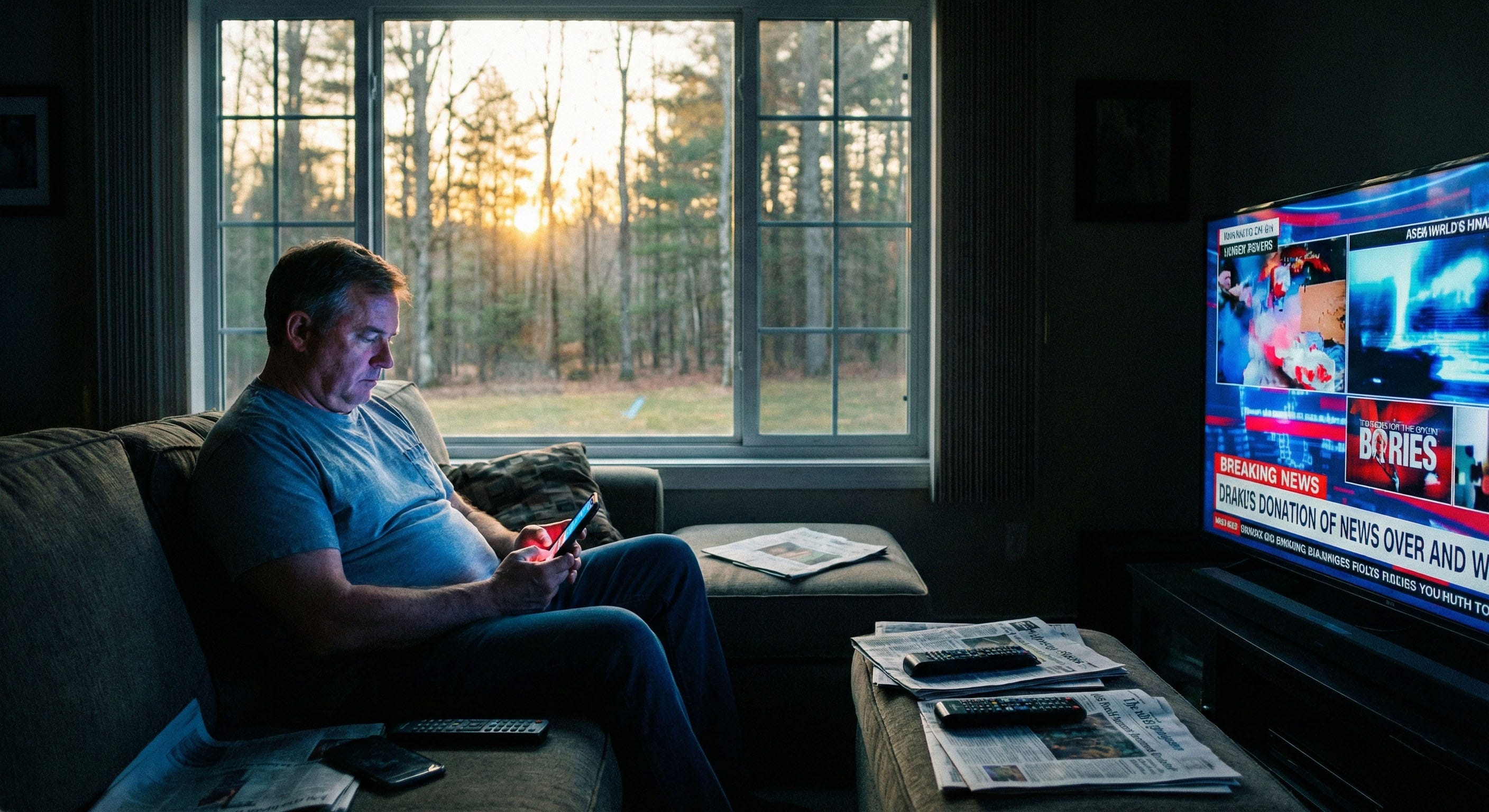
One of the things that led to the end of my previous marriage was my default state of crankiness and irritation.
My ex-wife and I were news junkies. 24-hour cable news played on the big screen in the living room all day long as background noise. I won’t get into the politics of it, but as you should be well aware, it doesn’t matter which side you’re on. If you follow the news daily, you’ll believe we are days or weeks away from some kind of apocalypse. Economic, social, political, environmental, existential. Take your pick.
In the morning I’d get in my car for a whopping 10-minute commute to work, turn on talk radio, and by the time I got to work I was enraged. Listening to someone I agreed with.
I’d think about the news throughout the day. Any moment I wasn’t focused on work, the news crept in. I’d furrow my brow and get angry in righteous indignation. And then I’d go home and turn on the TV, and the cycle would start again.
One thing my wife and I never considered was what this constant, never-ending stream of outrage was doing to our daughter. She absorbed all of it. She just didn’t have the tools to process it. Eventually we found out how hopeless it had made her feel about the future. We’d been so busy being “informed” that we poisoned our own kid’s outlook on the world without even realizing it.
That’s not being responsible. That’s negligence disguised as civic duty.
I did eventually wake up and realize that my being angry and “informed” was pointless. It didn’t change anything. Whatever was going to happen was going to happen regardless of whether I knew about it. So I stopped watching and listening.
For a while.
Eventually, like the Sirens’ song, it drew me back in.
Here’s the thing about the news that I don’t think a lot of younger people realize, and older ones have forgotten: Up until CNN launched on June 1st, 1980, people didn’t think about the news every waking moment of their lives. There was the 6:00 news and the 10:00 news. Mainly local. What’s happening in your town, some national, maybe a bit of international, sports, and weather. Crammed into 30 minutes. People didn’t take breaks at work to rant about the President. They talked about work. Family. Sports.
When it went to a 24-hour format, the news became a business. It needed viewers, advertisers, high repeat engagement. It became a profit center. Entertainment, of a sort. And that’s when it changed from something that informed you about what was happening to something that told you what you should think about what was happening.
The editorial page of the newspaper became the entire newspaper.
Front page, and every page within. They needed you angry and scared. They needed you plugged in constantly, because God knows what might happen if you looked away.
Then about 20 years later came online social media. It started innocently enough. MySpace. Facebook for connecting with friends and family. But that didn’t generate enough engagement, and soon the outrage seeped into your feed, peppered between your cousin’s freshly baked bread and your friend’s motorcycle ride. Then came Twitter. It didn’t take long for that to become an absolute cesspool of anger and hate.
Back in the days when I ran Screen Rant, sometimes the comment section would get out of hand. Legit heated arguments about the proper shade of blue for Superman’s suit. Most commenting back then was done under pseudonyms, and I remember thinking, “If people had to use their real names, the internet would be a more civil place.”
I was wrong.
I eventually watched people on Facebook — where your real name, your city, photos of your family are all one click away — reply to strangers with the most despicable things imaginable. Without a care in the world about their identity being attached to it.
Absolutely crazy.
And I fell right back in with them. I got sucked back into the “I have to be informed” mentality, and I was constantly pissed off. Often hateful. I was treating my attention like it was disposable, like there was no cost to dumping outrage into my own head eight hours a day.
There was a cost. There’s always a cost.
My current church takes its congregation through a 28-day digital fast every year. I tried it for the first time last year, and it was TOUGH. At first. Delete social media and news apps from your phone. Only use apps that are for utility: messaging, finances, health, etc.
The first week, it was shocking how often I’d mindlessly reach for my phone to “see what’s going on.” I’d catch myself constantly, and put it away. But after a while, it really wasn’t that difficult. I spent more time in the moment. If I was in a waiting room, my head was up, not hanging down staring at a screen. I’d look around. Engage with other humans who didn’t happen to have their faces buried in their phones.
My mood changed. I was calmer. My mind became occupied with other things.
At the end of the fast, my usage dropped dramatically. Eventually I did drift back toward news and social media, albeit less than before. But by the end of the year, I was right back to doomscrolling on X in any spare moment.
So at the end of last year I decided I was finally done. Cold turkey. I did my own digital fast in January, and here we are three months later. I barely know what’s going on out there, and I don’t care.
Some might call me ignorant. That’s fine. I pop into Grok once every couple of weeks and ask for an unbiased summary of what I’ve missed. Just the highlights. And sorry for the language, but it’s same shit, different day. The names change, the situations and locations, but it’s the same thing. Politicians and people in power doing their best to keep us all at each other’s throats.
Finally, brothers, whatever is true, whatever is noble, whatever is right, whatever is pure, whatever is lovely, whatever is admirable — if anything is excellent or praiseworthy — think about such things.
Philippians 4:8
Paul didn’t write that because it sounded nice. He wrote it because he knew what happens to a man who fills his mind with garbage.
You become the garbage.
Since unplugging, my productivity is the highest it’s been in years. My marriage is better. I’m easier to live with. It’s been like an open wound that’s finally been allowed to heal.
You’re awake about 16 hours every day. Open your screen time dashboard on your phone and look at how many of those hours you’re spending staring at a little screen in your hand, feeding yourself things that make you a worse version of who you’re supposed to be. Make it a goal to make that number smaller. Much smaller.
The man I was when the news ran my life: cranky, irritable, carrying anger into every room he walked into. I don’t miss him. My wife doesn’t miss him either. My daughter shouldn’t have had to grow up with him.
You can’t rebuild yourself on a diet of outrage. At some point you have to decide what you’re going to let into your head, and what you’re going to starve. That wound won’t heal if you keep cutting it open every morning at 6 AM.
Unplug. Guard what goes in. The man you’re building in the second half depends on it.
Here is a resource to help you unplug — it’s the Digital Fast Workbook that took me through my first fast.
Vic built and sold ScreenRant.com and GameRant.com, then rebuilt himself in his sixties.
He writes at TheRedeemedSecondHalf.com for men rebuilding the second half of life.
"You can’t rebuild yourself on a diet of outrage” definitely resonates. What a man consumes daily eventually shows up in how he leads, loves, and lives.
It is interesting to me that even though folks know their nerves are shot by listening to outrage culture, they love swimming in the current.
I have not logged onto any platform in a year, except this one. And I completely cut out all news / cable / political outlets in 2021. There is no way I would go back, or participate in that kind of drama.
But how can you stay abreast of important events my friends ask? Easy. Everyone around me tells me (without asking).