


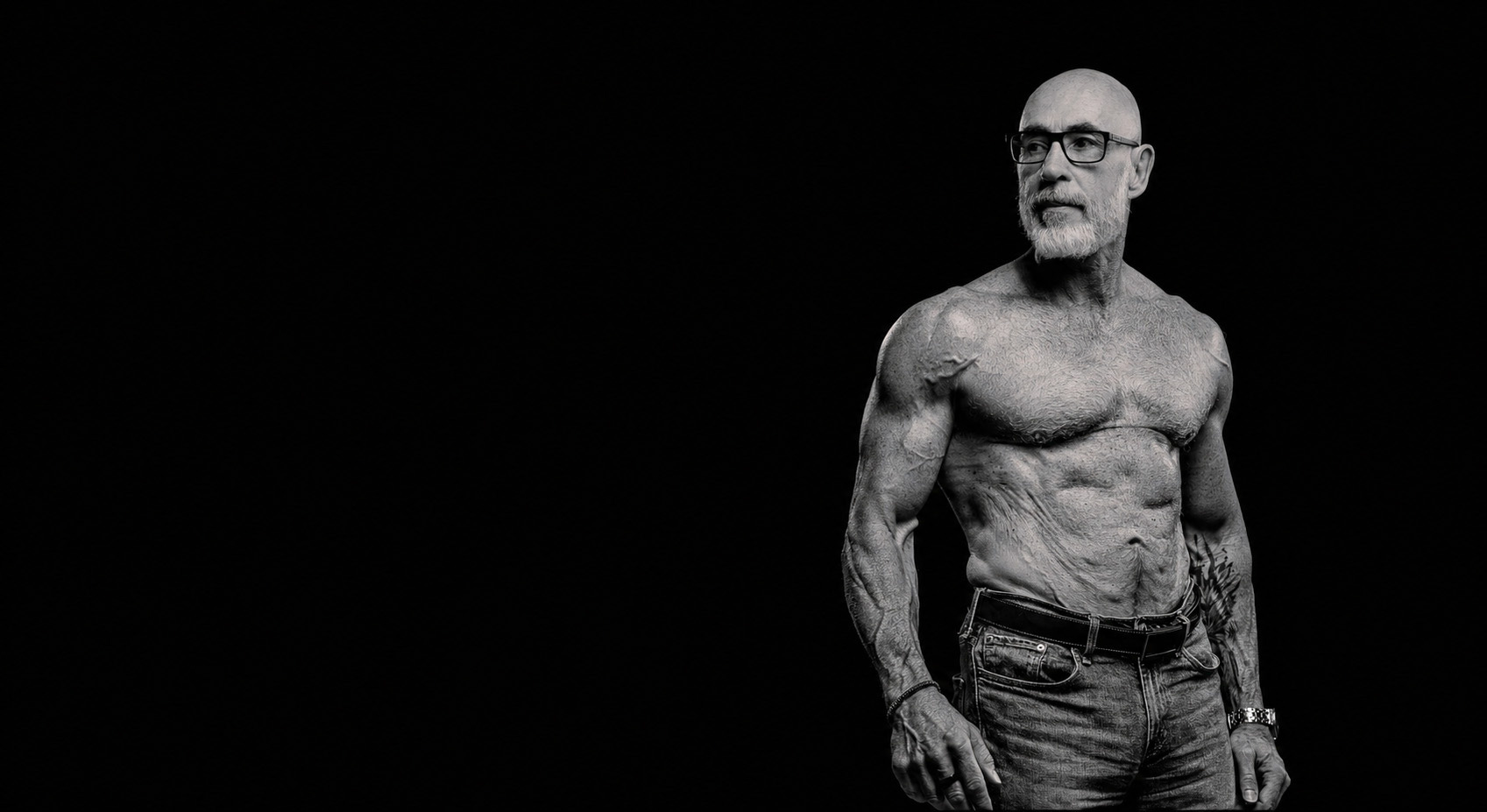
Adapted from Chapter 3 of my book The Last 10 Pounds.
The body in this post is what I started with — before any of the work that became “You Don’t Need More Sets.”
I can trace the chain. It starts small and specific, becomes a cascade, and by the time I’m sixty-four, I’m standing in front of a mirror looking at what fifty years of structural compromise looks like.
Here’s what’s different about this part of the story: I can’t blame the choices I made. The body I was working with wasn’t the result of bad decisions or neglect. It was built that way. It was broken before I had any say in the matter.
Part one: the origin
I was born with a right clubfoot. It was corrected in infancy with surgery, casting, the whole protocol. It worked. I can walk normally. The correction came with a permanent cost, though: my right foot is two sizes smaller than my left. My right calf is a full three-quarters of an inch smaller in circumference. The muscle insertion is higher. The entire right leg is measurably smaller than the left.
What that means is asymmetry. Built in, structural. It doesn’t fix itself.
When I was a kid, shoes were a nightmare. I had to buy two pairs and throw one away. One shoe fit my left foot. The other fit my right. I’d walk out with paired shoes, each one wasted by half. Junior high, I wanted to try track and field. My mother said no. She was certain I’d get hurt. The clubfoot, she thought, meant I shouldn’t push it. So I didn’t, and I wasn’t that invested anyway. But I was aware, even then, that the foot was making some of my choices for me.
As I got older, I became self-conscious about it. I had a limp. It wasn’t severe, but it was there. I knew it was there, and I was old enough to know that other people could see it too. That does something to you. You carry it differently, stand differently. You start to own the thing you’re self-conscious about by changing how you move. My mother’s protectiveness fed into that. She meant well. What I got was a message: your body is fragile. Be careful. Don’t push it. When you’re young, that message sinks in deep. It becomes part of your operating instructions.
Part two: the cascade
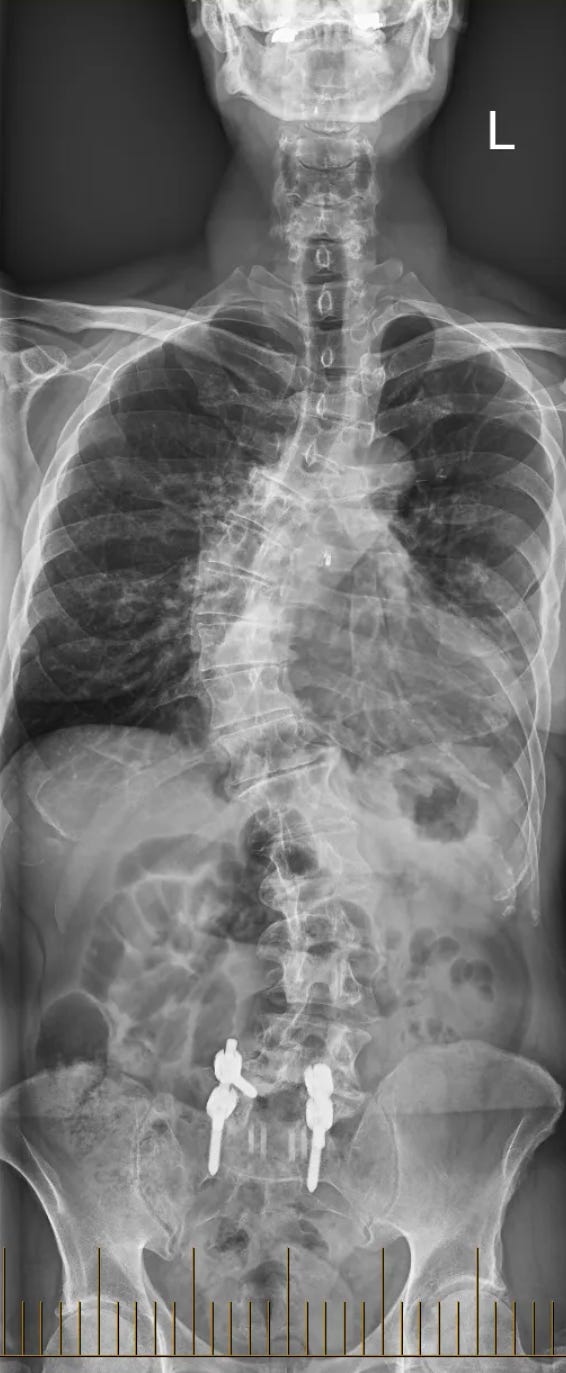
Here’s how the body works: one thing isn’t just one thing. That leg-length differential, smaller right foot, smaller right calf, smaller right thigh, creates a pelvic asymmetry. One side of the pelvis is slightly higher than the other. The body compensates. The spine curves to make up the difference. That’s how structural scoliosis develops.
The scoliosis isn’t just a sideways bend. It’s also rotation. The vertebrae twist. The ribs twist with them. When your rib cage is twisted and compressed, it changes the shape of the space inside. Less room for the lungs. Less room for full expansion.
That’s why I can’t breathe like other people do.
My lumbar spine is fused at L5 to S1. I had that done in my early forties. It was necessary. Fusing vertebrae means those vertebrae don’t move anymore. The joints above and below have to work harder. That’s a trade I made and would make again.
Then there’s the pectus excavatum, a depression in my chest wall from the thoracic twisting. It takes up room that the lungs need.
Put it together: clubfoot at birth. Pelvic asymmetry from the leg-length difference. Structural scoliosis with rotation. Thoracic cage distortion. Pectus excavatum. Lungs that have sixty-six percent of the capacity they should have. Each thing flows from the one before it.
I got my lungs tested. 66% of predicted for my baseline. Restrictive pattern. That’s the medical way of saying my lungs can’t expand the way they’re supposed to. Not because the lungs themselves are diseased. Because the cage around them is too small. It’s like trying to blow up a balloon inside a box that doesn’t fit.
Part three: the surgical timeline
I’ve had eleven adult surgeries, two as a child.
The clubfoot correction came first, when I was an infant. Hernia repair in childhood. Then the real machinery kicked in.
Right ACL replacement sometime in my late 30s. Lumbar spinal fusion, L5 to S1, around the same time. Those were the foundation-level surgeries.
Knee surgery again in March 2014 for the meniscus. Sinus surgery in 2016. Eye surgery that same year to correct the onset of double vision. September 2017: pectus bar surgery. The thought was that pulling the sternum outward would give the lungs more room to expand. It didn’t work. In November 2020, a second surgery to remove the bars. Two surgeries to learn that you can’t fix the rib cage problem when the problem is the spine. September 2020: prostate surgery.
Then a snowmobile accident. Violent tear to the rotator cuff when I hit the ground. Surgery in April 2021 to repair it. Four weeks into recovery, I reached for something I shouldn’t have been reaching for. The bicep tendon detached from the shoulder, right where the first repair had been made. Bicep tendon reattachment in May 2021. Two surgeries in four weeks.
I did okay for a long while. Then I got stupid in the gym. I’d been running my usual weight and reps on barbell press for a long time. I decided to go heavier: a 5x5 protocol. The rotator cuff gave out right at the previous repair site. June 2024. I went through surgery, and a few months afterward, the supraspinatus detached and retracted so far it was irreparable. They couldn’t reattach it. I’ve got most of a rotator cuff now: the teres minor and subscapularis intact. One big one gone, and another at less than 100%.
Eleven adult surgeries. That doesn’t even count the clubfoot correction, the hernia repair, or the Vespa wreck.
Part four: January 2022, Puerto Rico
I’d taken an introductory scuba course. The weight belt wasn’t calibrated right. I’d make an adjustment and start sinking. Then a small counter-adjustment and rise very quickly. Over and over for an hour. When it was over, I got on my Vespa and left the parking lot.
The next thing I knew, I woke up in a hospital.
I’d blacked out, presumably from the repeated rapid pressure changes. The Vespa went into a palm tree. Deep gash on my arm that needed stitches. Cracked vertebrae in my neck. Broken nose. My left knee had grade three tears in the ACL and MCL. The doctor wanted to operate.
I was done with surgery. Not afraid of it. Exhausted by the recovery. Six months to a year of rehabilitation every time. I just said no.
Over time, the knee stabilized. Not perfectly. I learned which movements to avoid. For walking and for the workouts I do, it’s held up.
Part five: breathing at sixty-six percent
I can lift weights. But squats and deadlifts, my legs will still have strength to give before my lungs run out. Then I stop the set. I step back. I’m heaving for breath. Sometimes it takes a couple minutes to settle back down.
Sometimes I’ll be sitting on the couch. Not moving. Not exerting myself. I start to feel short of breath. There’s a tightness, like I can’t inhale fully. It’s like breathing through a steel belt cinched around my ribs.
When I lie down to fall asleep, it gets worse. The position changes how the rib cage sits. I feel like I can’t take a full breath. Sleep gets harder.
I started doing Schroth exercises recently. They’re designed to counter the rotation and curvature. The intent isn’t to straighten a curve that’s been there fifty years. It’s to make the spine and rib cage more flexible. I’m already feeling a difference.
Part six: the current inventory at sixty-four
Fused spine from L5 to S1. Structural scoliosis with a kyphotic component, the forward curve, the way the thorax rounds. Right shoulder on a three-fourths rotator cuff. The supraspinatus is detached and gone. The infraspinatus is torn. I’ve got the teres minor and subscapularis still functional. It’s not nothing, but it’s not a full set of tools either.
Restrictive lung pattern. Two-thirds the breathing capacity most men my size have. Bilateral knee ligament history. The right knee is older damage. The left knee is from the Vespa wreck, the grade three tears that never got surgery. Both are compromised in different ways. My left knee is going to need a full replacement at some point. I can feel it.
I’m an inch and three-quarters shorter than I was in my twenties. The spine collapses slightly in the thoracic region. The body gets smaller. Congenital right leg asymmetry. Right foot two sizes smaller, right calf three-quarters of an inch smaller, right thigh smaller. That difference is built in. It doesn’t go away.
This is the body that did everything you’re about to read about in the rest of this book.
Whatever you’re working with is probably less compromised than this. You didn’t pick the body you got. What you do with it is the only part you control. Most men spend their second half hiding behind less and calling it a reason.
Decide which one you are.
Adapted from Chapter 3, The Last 10 Pounds. Out summer 2026.
The Last 10 Pounds is how I stayed lean across 15 years of surgeries, a wrecked knee, four moves, and a divorce, on 66 percent lung capacity and 34,000 logged food entries. The Kindle edition is available now for $9.99. The first chapter's free on my website:

Vic built and sold ScreenRant.com and GameRant.com, then rebuilt himself in his sixties. He writes at TheRedeemedSecondHalf.com about faith, identity, and the second act.
Vic, thank you for your transparency and openness when sharing your physical realities, experiences, and challenges. Today’s writing is awesome and super encouraging.
I’m not dealing with many major physical challenges, but can see age related issues trying to sneak in the door and my goal is to keep it shut as much and as long as possible. I’ll be 69 in July.
The past +2 years I’ve made some good diet changes that I’m still modifying. The past 6 months I’ve upped exercise a level by adding more intensive weights work outs including your comments on slower reps being better.
A major improvement I’ve seen is improved balance. Add to that small strength increases and also looking a bit better, I feel motivated to keep on keeping on.
Thanks again for writing encouraging and challenging articles.
Sorry my comment got so long.
Thanks for this and for your perspective. I've been a bit whiney this morning and I need to get over it. After an infection last year, had L2-L5 fused and had to learn to walk again. I'm still gimpy but I've realized I can't just wait to get better. I have to work on it. Dammit.