


For over two decades, I was the provider and the head of the household. I had a role. I had a reason to get up in the morning that didn’t require any thought at all.
Then the marriage ended, and it all evaporated. Without the role, I didn't know who I was.
Six years later I’m remarried and I cook the best steak you’ve ever eaten. Everything nobody warns you about sits between those two facts.
When my 24-year marriage ended, I was 59 years old and I couldn’t cook a meal. Not “I wasn’t a great cook.” I could make scrambled eggs. That was it. I stood in Target staring at spatulas not knowing which one to buy, because I’d never needed to know. My ex-wife handled the kitchen. I handled the income and expenses. That arrangement worked great… until it didn’t.
Suddenly I was a grown man who didn’t own a can opener.
I rented a furnished apartment that looked like a safehouse. Four walls, a couch, a bed. No art, no warmth, nothing that said a human being with a life lived here. If the police had raided it, they’d have assumed I was about to flee the country.
I didn’t know what temperature to wash clothes. First load: red t-shirt, white towels. I became the proud owner of several pink towels.
Funny stories. Easy to laugh at now. Underneath them was something I didn’t find funny: two decades of marriage had let me outsource half of being a functioning adult. I never noticed, because my role never required me to.
Maybe you did this too
If you spent decades in a marriage, you have your own version of this. Your role let you skip half of the work. You handled your lane, she handled hers. Over 20 or 30 years, that split stopped being a chore chart and became who you are.
You lost a wife. You also lost the thing that told you who you were every morning without your having to think about it.
That’s why starting over feels like more than grief. It feels like erasure.
At 35 you knew exactly who you were: husband, provider, father, the guy with the answers. At 55 or 60 you’re standing in a grocery store not knowing the difference between a shallot and a small onion. The shallot is beside the point. You built your identity on a foundation someone else could walk away from.
The roles you hid behind
The role was convenient. It was also a place to hide.
When you’re the provider, you don’t have to figure out who you are beyond the paycheck. When you’re the husband, you never have to ask whether you like your own company. The title answers “who are you” before anyone asks, including you.
I hid behind all of it. I was the guy who built and sold major websites. The Navy veteran. The breadwinner. Impressive-sounding labels. But when they got stripped away, I realized they were descriptions of what I did, not who I was.
My closet told the story. Most of it was a decade old. I was dressing like a man who peaked in 2009 and decided to ride it out. Cargo shorts, oversized t-shirts, white socks with sneakers. A uniform for a man who’d stopped thinking about who he wanted to be.
Recovery is the wrong goal
The instinct after divorce is to recover. Get back to normal. Get the old life back.
That’s backwards. The old life only worked because she was in it. Getting it back would just rebuild the dependency with the next woman. What helps is the terrifying part: starting from nothing.
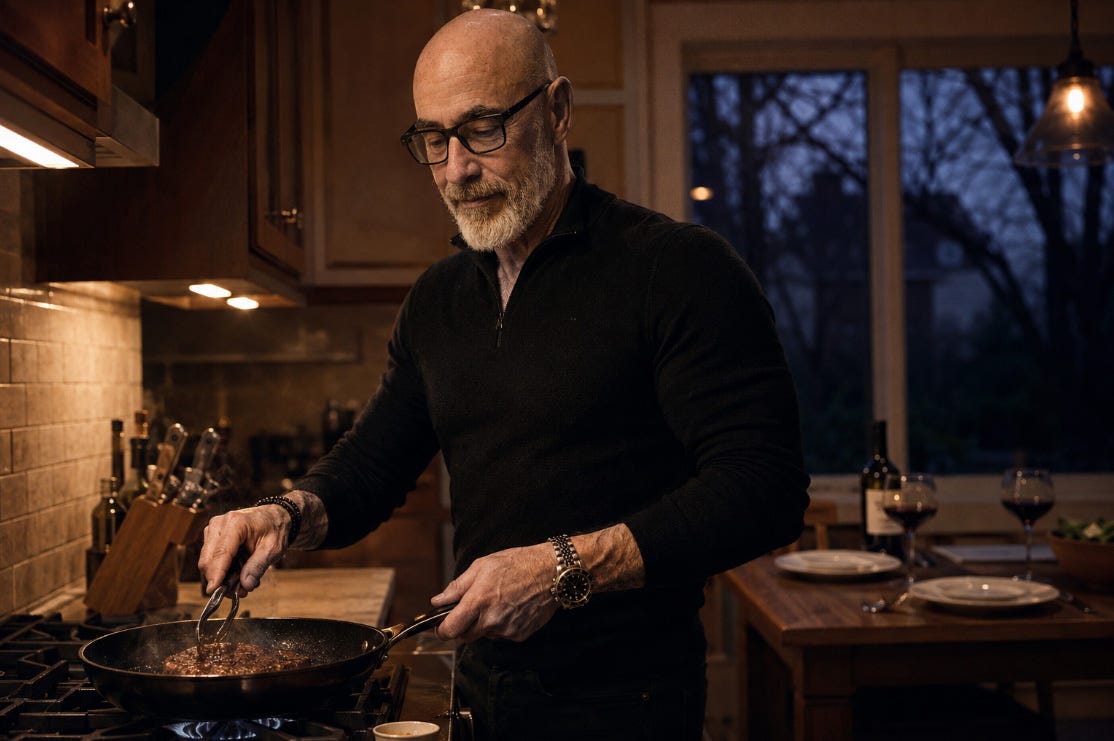
I learned to cook at 59. I didn’t want to become a chef. Feeding myself was the most basic self-sufficiency I’d never built, so I found a YouTube channel, watched some videos, bought a sheet pan, and started. Today I cook a great steak. I decided a skill gap was unacceptable and I closed it.
I rebuilt my wardrobe from zero. Found my own style. Not my ex-wife’s taste. Mine. That was one of the first outward signs my rebuild was real.
I learned to be alone. That one took longer than any of it. The first six months of sitting in a quiet apartment on a Saturday night when you used to have a house full of noise. That rewires something in your brain. I moved from Utah to San Juan, made friends, built a social circle around a cigar bar and a standing invitation. Then the group faded, and I was left facing what I’d been masking: a deep loneliness I didn’t know what to do with.
I turned 60 with no party, no plans, no one organizing anything. Birthdays in a marriage just happen. When you’re single and new to a city, turning 60 means sitting in a sparse apartment wondering what you’re doing with your evening.
I’m not telling you this for sympathy. When the marriage ended, nearly every friendship and standing plan I had ended with it, because all of them ran through the marriage. The married friends who stayed ran on a different clock:
Them: “Let me check my calendar and see if the wife has any plans.”
Me: “OK.”
Them: “How about two weeks from Thursday?”
I didn’t blame them. That was me, not long before.
The man on the other side
I ended up in Nashville with a roommate. After having built and sold two major websites, serving in the Navy, and being married for 24 years, I was 60 years old, splitting rent.
Eventually I stopped trying to find someone to fill the gap. I stopped dating and stopped looking. Something shifted. I settled into being okay with myself, and this time it wasn’t a performance.
At first I ate dinner alone at restaurants and pretended to be fine with it. Eventually, I stopped pretending. I really was fine with it.
A couple months later, I met the woman who became my wife.
“Forget the former things; do not dwell on the past. See, I am doing a new thing.”
Isaiah 43:18-19
That verse hangs on a wall in our home. It was the theme of our wedding. I didn’t find it. It found me, somewhere between the pink towels and learning to be okay at a table for one. God was doing the new thing. I still had to learn how to live in it.
The role is gone. Now what?
If you’re reading this and your old life just collapsed, I won’t tell you it’s going to be fine. It’s going to be humbling. You’ll be a beginner at things teenagers do without thinking. You’ll feel ridiculous, sitting in a quiet room with no idea what to do with yourself when no role is telling you who you are.
Good.
Because the man who comes out the other side of that (the one who learned to cook, dress himself, be alone, and sit at a table for one without flinching) chose who he is. Nobody handed it to him.
The first half, someone else helped define you. The second half, that’s on you.
Click here to subscribe:
Vic built and sold ScreenRant.com and GameRant.com, then rebuilt himself in his sixties.
He writes at TheRedeemedSecondHalf.com for men rebuilding the second half of life.
Love the Bible verse from this article. Letting go of the past is one of the most difficult (and necessary) skills to learn.
I learned a lot as a single Dad at 32. I wouldn’t trade my time with my kids for the world.