


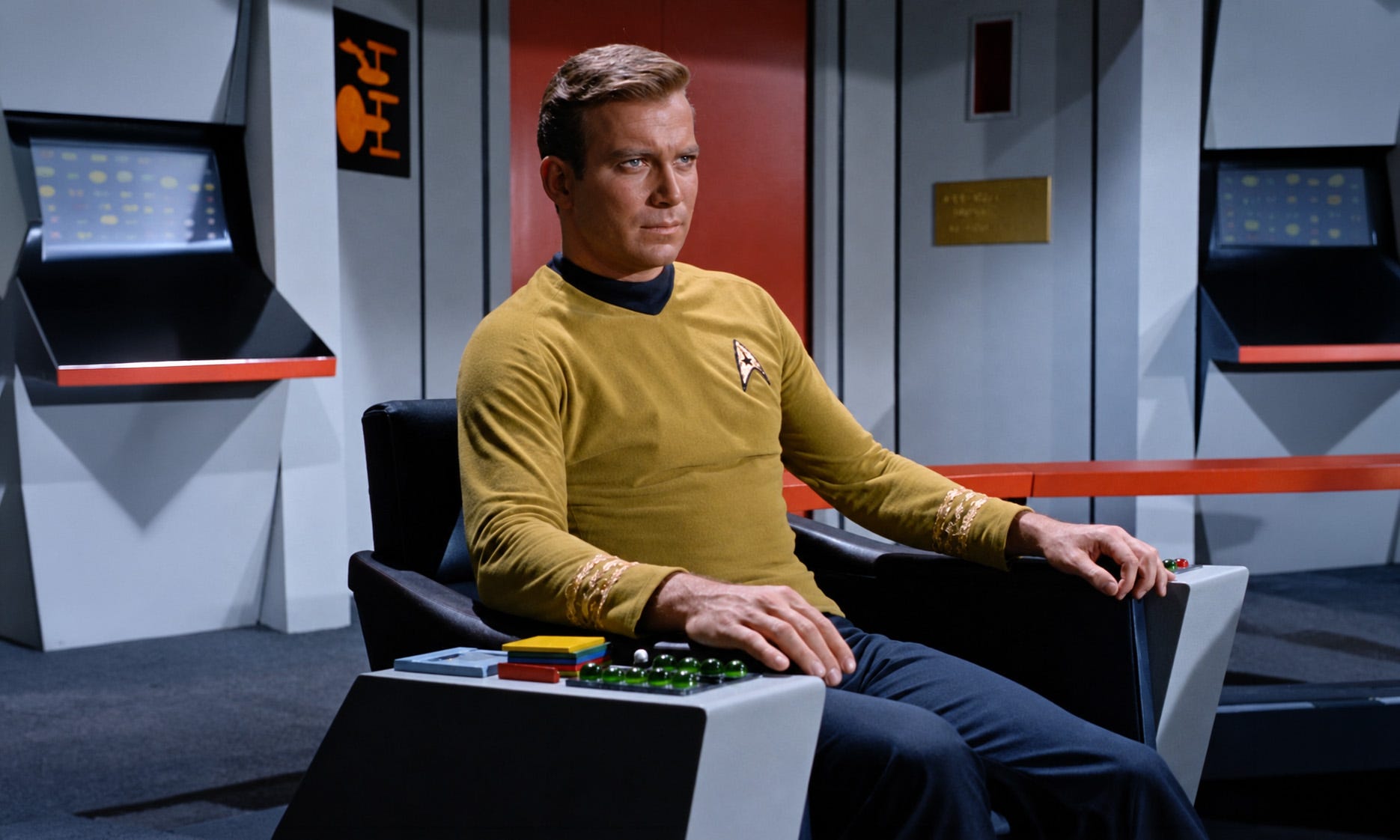
I learned what decisiveness looks like from a starship captain.
In an earlier essay, I wrote that every man needs at least one thing in his life that makes him grin like an idiot when he sees it.
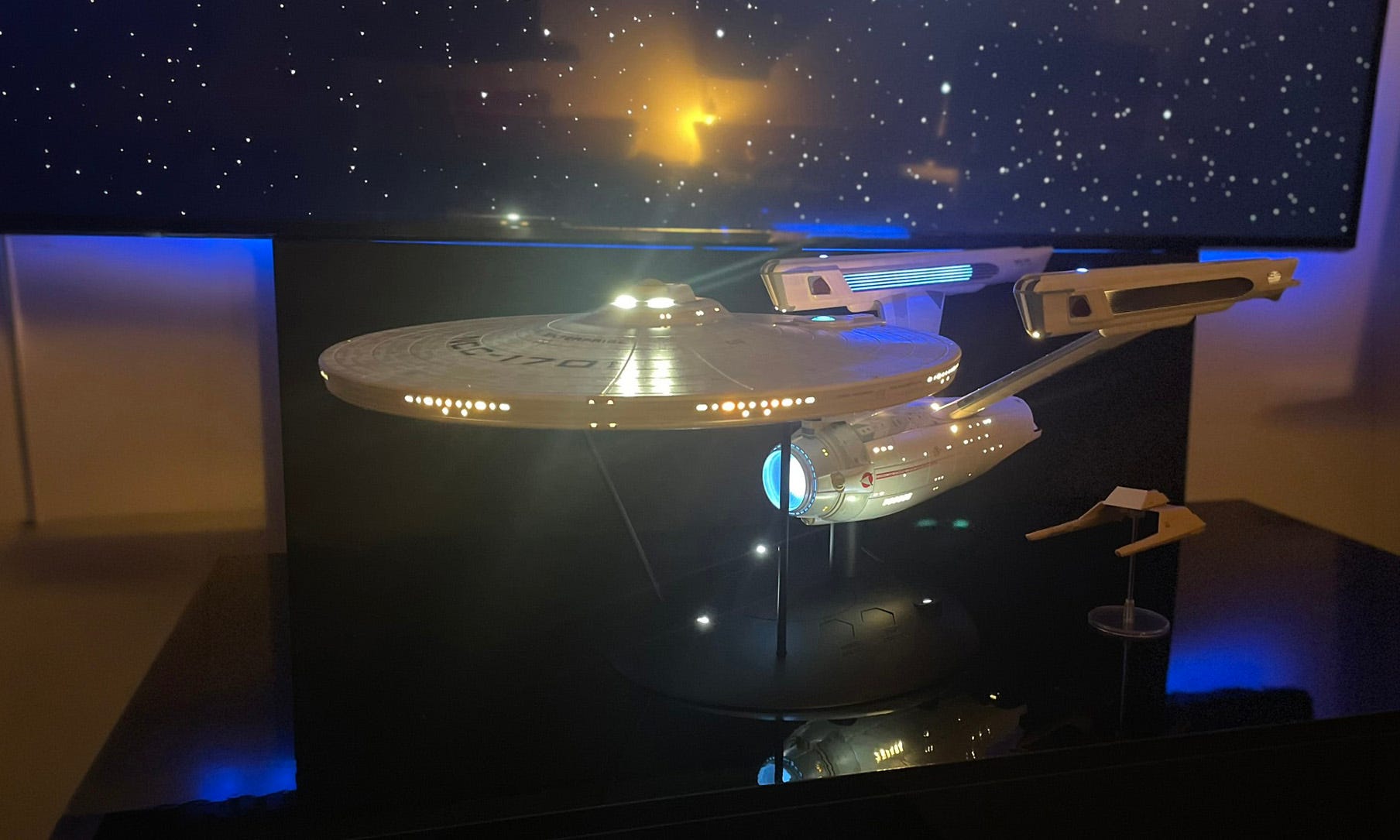
One of mine is a 34-inch die-cast model of the refit Enterprise from the movies on a table in front of my TV. It lights up like it does in the movies, and you can see the arboretum and the shuttle bay inside it.
Recently Star Trek had its 60th(!) anniversary. I didn’t watch when it originally aired on NBC. I found it in reruns in the early 70s, after NBC had canceled it and before anyone knew it would become one of the biggest entertainment franchises in the world.
The show was expensive to produce by the standards of its time. The attention to detail and budget showed on the bridge of the Enterprise. The room really looked like a place from which people could operate a starship. Everyone had a station, and all information flowed to the man in the center chair.
The ship itself was one of the coolest ships ever seen on the screen. I still say that the refit Enterprise from the first film is the most beautiful spaceship ever to appear on a movie or TV screen.
The future it promised
The equipment was only part of what made Star Trek different.
The show’s writers and designers tried to imagine how people might communicate, navigate, diagnose illness, and travel across enormous distances. The technology followed rules, even when those rules were fictional.
The larger promise was about humanity. Star Trek imagined a future in which people from different nations and races worked together, exploration mattered more than conquest, and our oldest divisions no longer controlled us.
The people in that future were still people. They encountered danger, made mistakes, lost their tempers, and disagreed about what to do next. Better technology hadn’t removed the need for judgment.
That was where Captain Kirk came in.
The man in the chair
Kirk was a man of action, decisive and willing to fight for what he thought was right. His intelligence mattered as much as his nerve. He listened to the people around him and was willing to change course when the facts changed.
Spock gave him logic, probabilities, and the coldest reading of the situation. McCoy reminded him that logic couldn’t account for every human cost. Kirk listened to both of them, but the final decision always belonged to him.
In the episode “Balance of Terror,” chasing a Romulan ship that has destroyed Federation outposts along the Neutral Zone, he admits what the bridge crew can’t see:
“I look around that bridge and I see the men waiting for me to make the next move. And Bones, what if I’m wrong?”
McCoy can’t make the decision for him. Kirk returns to the bridge and continues the pursuit.
That scene matters because Kirk’s decisiveness doesn’t come from certainty. He doesn’t have certainty. He has information, competing advice, limited time, and responsibility for whatever follows.
Seeking counsel is part of command. Using counsel to avoid making the decision, isn’t.
Star Trek: The Next Generation made a different choice. There, Picard had a ship’s counselor on the bridge, sitting right next to him. Even watching back then, I found that to be ridiculous.
Picard called his senior officers together constantly, and he wouldn’t make a decision until he’d heard every one of their takes on a situation.
Both captains asked for input. The difference was what the asking was for.
In “The Corbomite Maneuver,” the Enterprise is trapped by an alien ship and given a countdown to destruction. Kirk asks for options. One officer already voted to attack, and Spock says there aren’t any:
“sometimes, as in chess, when one is outmatched, the game is over.”
Kirk takes neither option. Instead:
“Not chess, Mr. Spock. Poker.”
He tells Balok the ship is rigged with a non-existent “corbomite” device that destroys anything that attacks it. No one advised Kirk to bluff. It came from his own judgment, and it worked.
Picard went the other way. He’d often bring everyone in and come to a decision after he’d heard them all. It usually felt like a group decision instead of his.
I’m not saying Picard was weak. He made hard calls no one else would take. But watching the two of them back to back really highlights the difference: one man looks like he’s making a decision and the other looks like he’s waiting for permission.
Kirk could be impulsive, arrogant, and wrong. The captain’s chair made him responsible even when his judgment failed. He couldn’t hide behind a committee or blame the people who had advised him. Everyone on the bridge had a voice, but only Kirk could give the order.
The original show understood that strength and reflection could occupy the same chair.
None of us is likely to command a starship. But plenty of us will sit in rooms where other people are waiting for our decision.
When the chair was mine
A few months out from my divorce I was renting a place in the same city. I felt I couldn’t restart my life in the same place that I’d lived my old one. After some research, I decided to move to Puerto Rico.
My Utah friends thought I was crazy: I didn’t speak Spanish fluently, I didn’t know anyone there (other than one online friend), and the hurricanes.
On the other side, a couple of my friends I knew mainly online and had met just a few times in person said being a “digital nomad” was the way to go, and that I wouldn’t have to pay taxes on my capital gains. The weather was great, and it would be an adventure.
I made the decision pretty quickly, and set the wheels in motion.
Two months later I was in an apartment in San Juan.
It felt like the right move. I spoke some Spanish, found a tutor to teach me weekly for two months, and I thought Puerto Rico's Act 22 decree would pay off, since I was holding a good amount of Bitcoin.
It turned out I couldn’t understand 90% of what was spoken there. Puerto Ricans speak very rapidly with a dialect I couldn’t pick up, especially with my hearing loss. Crypto ended up going the opposite direction I’d hoped for, and in the end the move cost me thousands in taxes instead of benefiting me.
It turned out to be a temporary move, but I’m glad I did it. It shook things loose for me and looking back I’m glad it’s added an interesting page to my life history.
The stakes were different, but the decision was still mine. I listened to everyone whose opinion I trusted, but didn’t ask any of them to make the decision for me.
The final decision
It happens in business, marriage, fatherhood, and friendship. You gather the information available. You listen to people whose judgment you trust. None of them can remove the uncertainty.
Then you decide.
Good advice improves your odds, but it can’t carry your responsibility. Spock could give Kirk the numbers, and McCoy could tell him what the numbers left out, but it was still up to Kirk to choose.
My friends could tell me whether I should move to Puerto Rico, but I was the one who had to live there.
This is what I write about every Sunday for men who took the hit and still have to decide what's next.
Vic built and sold ScreenRant.com and GameRant.com, then rebuilt himself in his sixties.
He writes at TheRedeemedSecondHalf.com for men rebuilding the second half of life.