


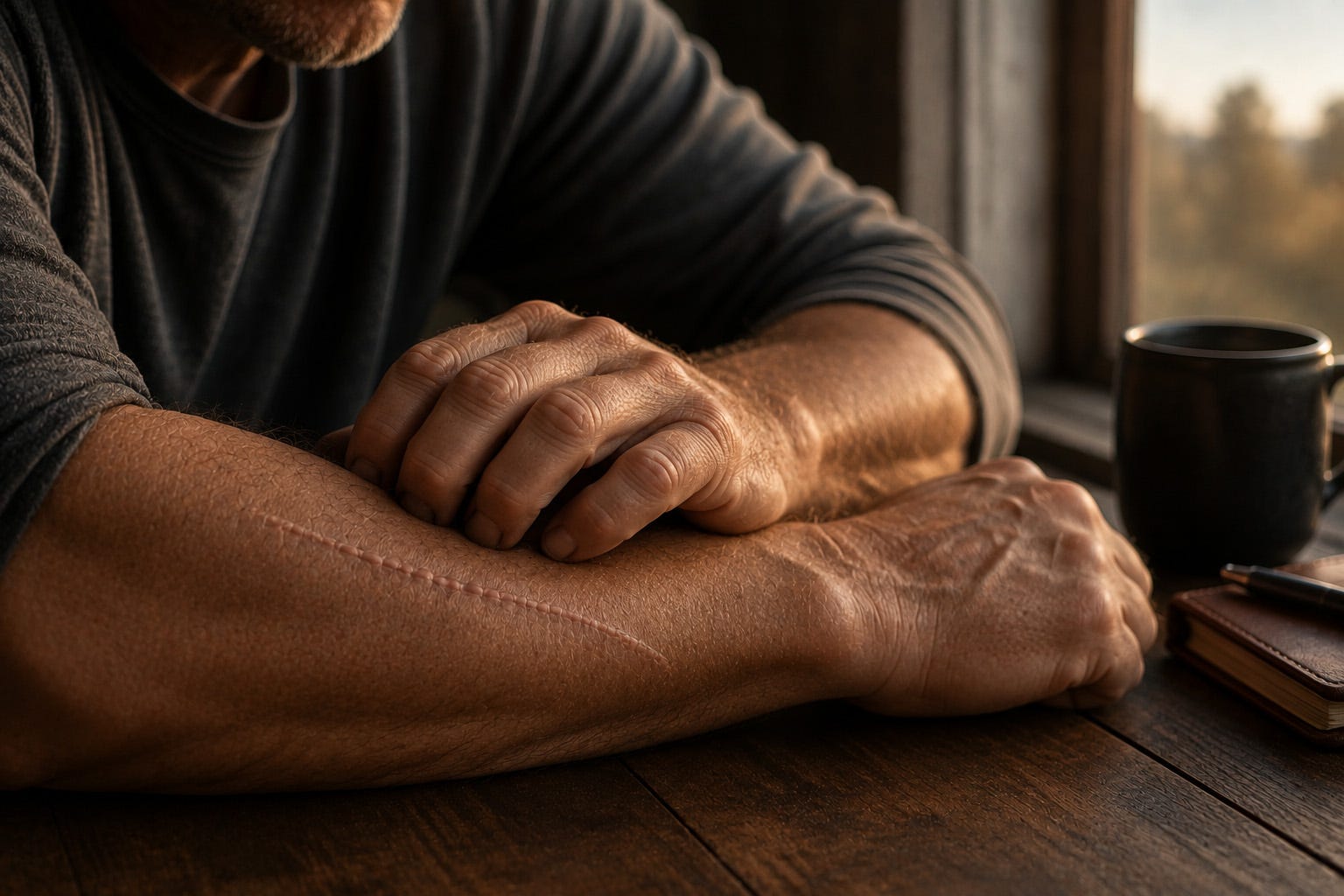
Thirteen surgeries have left a map on my body. I can trace most of my scars without looking: my shoulder, three times. My chest. Spine. Knees.
Every one of them closed. Skin does its work and moves on. It doesn’t reopen once a year to check whether the injury is still there.
Your body knows how to do this. But we have wounds of a different kind that stay open.
The wounds I was responsible for are another story. The failures with my fingerprints on them: the marriage I helped thin out, the years I justified myself instead of repairing anything, the seasons the people around me got the worst version and assumed that was just Vic.
I’ve repented of (most of) those things. Named them, owned them, made what repairs could still be made, turned and tried to walk a different path.
There are people who keep going back – for years. Replaying their worst chapters like there was going to be a quiz.
I have a line I stand behind:
Scars prove you’ve healed.
Keep picking at scabs and they’ll never heal.
Repentance and acceptance close wounds
Repentance is a completed action. It has stages and an end: you name the thing and you don’t make excuses for it. You own your half without footnotes about hers or theirs or the circumstances, you repair what can still be repaired, and you turn. It costs pride and the kind of conversation you might rehearse in your head before you say it out loud. Anyone who tells you repentance is cheap has never done it.
You know it's finished when there's nothing left to confess, nothing left to repair, and the man you're becoming wouldn't choose it again.
Acceptance of a wrong done to us is the flip side, but similar. Name the thing, and recognize that another person's actions say more about their character than your worth. Usually this conversation happens only in your head, though it may help to share it with someone you trust. If for no other reason, to help you not slip back into victimhood over it.
Here’s their signature, though: they finish. The wound closes, and the scar left behind is the proof of the healing. The tissue is different there, stronger in some ways, and it may ache in cold weather. But it’s still closed.
Rumination reopens
Picking at a scab is different. The 2 AM session where you replay a conversation from 2011. The anniversary you keep for your worst mistake. You reach for the old failure whenever life gets good, like a man touching a stove he knows is still hot.
There’s a quieter version of picking that deserves its own mention: the man who won’t let anything be good because of what he did. He gets the promotion, the new marriage, the grandchild on his knee, picks that exact moment to remember who he used to be, and he finds a way to mess up the moment. “Enjoying this, are we? Well, we’ll have to do something about THAT.” He makes sure no scar is ever allowed to fade into ordinary skin. I’ve done it. Sometimes I still do.
Every time you pick, the wound starts over. Repentance ends in something: an apology sent, a behavior changed. Forgiveness gives peace. Rumination ends in fresh pain, and the pain feels like virtue. I spent years believing the replaying was accountability, proof I wasn’t letting myself off easy. It was unbelief wearing a humble face. God had already forgiven those sins. I kept going back because some part of me trusted my own verdict over his.
The fire on the beach
There’s a scene at the end of John’s Gospel that settles this. Peter has denied Jesus three times, the worst failure of his life, and both of them know it. The risen Jesus builds a fire on the beach and asks him three questions, one for each denial: do you love me. Peter says yes three times.
Jesus said, “Feed my sheep.” (John 21:17)
Look at what’s missing. Jesus never brings up the denials. Three wounds, three questions, and then a job. Restoration, in the hands of the one who invented it, ends with an assignment, and the assignment is the proof that it’s finished.
Trace them and move
Here’s the test I’d hand you for whatever you keep revisiting: ask what the visit produces. If it’s producing repair, an apology you still owe, a pattern you still haven’t changed, that’s repentance finishing its work. Go finish it. If the visit produces nothing but pain, if you’ve repaired what can be repaired and you’re going back anyway to bleed on schedule, that’s picking, and picking is the one thing guaranteed to keep a wound from doing what wounds want to do.
Remembering is different. You should know your own history. Your scar is supposed to be visible, and telling its story honestly is half of why what I have to say is worth anything to you. The line sits between remembering and re-litigating: one recounts a closed case, the other petitions to reopen it.
The wound is trying to close. Let it.
Great read. You can learn from something without putting yourself back on trial every time you think about it.
Rumination truly is a bane. Next time I find myself going that route, I'll have to remember your words.